





How humility and hard truths restored Zheng Qinwen’s fire in Beijing
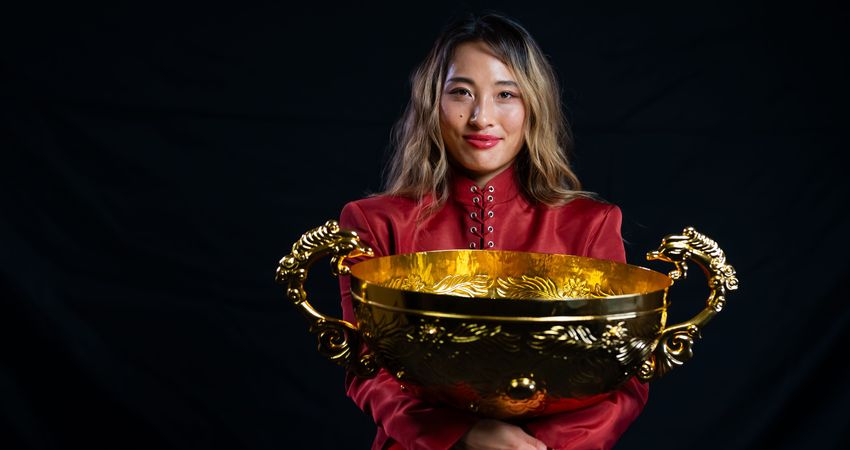
BEIJING -- During her China Open champion's press tour Sunday evening, Zheng Qinwen showed off an elegant, custom Nike dress designed dress in her favorite color, China red.
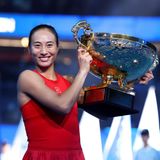
In Chinese culture, red symbolizes prosperity, energy and celebration, fitting themes for Zheng’s historic victory in Beijing. She became the first home player to win the event and captured her first WTA Tour Driven by Mercedes-Benz 1000 title.
Sunday night’s championship was more than a milestone. It marked the high point of a humbling 2026 season for Zheng, whose resurgent form -- 13-1 in her past 14 tour-level matches -- has helped her put the past year in perspective.
"Finally after many losses, I find my fire again when I'm playing the [competitive matches]," Zheng said in press. "Like I always said, tennis is not just about hitting the balls, it's also about how much you want to win. I am just so grateful that I found the inside fire back. Right now, I'm trying to reach the best version of myself."
Before Zheng’s US Open quarterfinal run as a qualifier, the past year had been anything but prosperous, energetic or celebratory. She was still recovering from right elbow surgery in July 2025 and working to regain her form.
The injury and the results -- or lack thereof -- frustrated her. Zheng returned in Beijing last year but retired in the third round, having rushed back to the court before she was fully ready.
It sidelined her until February in Doha, and she did not win three consecutive matches through Toronto, where she lost in the first round of qualifying. That low point helped Zheng develop a more mature perspective and accept the work required to rediscover her game: a rigorous training block, undertaken on the advice of coach Pere Riba.
"I thought the slump was one month, two months," Zheng said. "I did not expect it to be as long as six months. In the six months I was forced to learn a lot. Also I rediscovered myself. I knew that when I wasn't playing well, a lot of voices emerged. I learned to coexist with myself, to not be disrupted by those voices. All of those things make me stronger.
Zheng added that, in a letter to herself, she would stress the importance of staying humble in defeat and keeping her head up through a slump, with a reminder of all she had already achieved.

The US Open quarterfinal run and the China Open crown was the evidence of that turnaround, and her win in Beijing -- a tournament she dubs as the fifth Grand Slam -- brought her another prosperous, energetic and celebratory moment that she'd been looking for since her last title in 2024.
After the final, wtatennis.com sat down with Zheng one-on-one. Here's more from the conversation:
After your success in 2024, you became a national icon for your country, and the win proved that even more. What's it like being so well-known in China?
Zheng: It's not easy to be a national icon. Since two, three years ago I felt high responsibility on my shoulder because I want to behave well in front of [my] people. I want those young kids when they look at me, I am a good inspiration for them. I want to be a good example for them because I know how much the example can make a huge impact for the kid.
I remember when I was a kid I used to watch Serena [Williams], this iconic player, how much impact they can [have on] me. I wish I could make always positive stuff with them.
In mid-June, you were ranked No. 160 and remarkably, you are now No. 23. How did the past few months rejuvenate your motivation?
Zheng: Since I come back from injury, I've always [been] really motivated, but in the beginning, sometimes at the important moment, I couldn't handle the pressure. [For a] long time, I wasn't handling pressure, and I'm wasn't used to it since I came back.
Finally, my ranking gets where I used to be. Still not there yet, but I'm on my way. I would just like to keep this hunger, stay humble and let's see what can come in the future because I feel like there's still so much more in me that I didn't put it out. I want to achieve my limits.
You accrued 243 winners this tournament, the most of any player at any tour-level event this season. As you showcased your best tennis all season, can you share how your aggressive style fueled your win?
Zheng: Oh, that’s interesting [smiling].
I always want to become an aggressive player, and the problem is sometimes when you are so aggressive, you make more unforced errors. I learned that how to control my mistakes, and trying to find the right balance between making winners and controlling your unforced errors.
There's no place like home for Zheng Qinwen 🤩 #ChinaOpen https://t.co/7w8ZkSXBrh
— wta (@WTA) October 11, 2026
In this tournament, -- not only this one, but in the previous training before the tournament start -- I already started to make some game plan, trying to have a red spot in the training. Luckily I can show this in the match as well because sometimes you can play good in the practice match. Maybe you are not able to do that in a real match because all the pressure, all the emotion can affect how you impact the ball.
After facing so many losses, I finally felt that the pressure doesn't handle me anymore. I handle the pressure.
A huge figure in your journey has been your coach, Pere Riba. Could you expand more on his impact on you, particularly over the past few months where you reached one of your low points?
Zheng: It's true he made a huge change for me, and he saved me from the lowest moment when I lost that qualifying match in Toronto. Sometimes, it's really hard for his job as well, because if you want the player to perform as good, you need to be tough on court.
What’s happened in the past is maybe I was not humble enough to [hear] this hard [truths, this hard training, because I felt I'm already one of the best. I wanted to show that I know more than [him], and after many losses, I realized that's not the way.









If you want to win, you need to stay humble and listen to your coach, so I find in that moment I made a click and we've been working really well. He really did a lot of changes in my game -- also to my mental side -- because he's always the one who trusts me how much I can achieve. When I feel I'm at my limits, he's always there to push me more because he knows I have so much more in me that I can give on court.
There wasn’t an empty seat in the stadium tonight, a testament to your fandom. How did the atmosphere tonight compare to any other experience you’ve had on tour?
Zheng: China Open for me is like the fifth Grand Slam, and in this tournament, it's one of them I need to really give everything. I really appreciated today there is no empty seat, because I felt all the people that want to come to watch me play. I felt extra energy to fight there on court.
I always say that if I can reach [further rounds], people will know more about tennis. I know Chinese people, they like to see Chinese players compete because we have a big honor for our country, and I would really love more kids to know tennis, this sport. But no empty seats, that's quite amazing.