








2018 US Open Final Preview: Serena and Osaka chasing legends with history on the line
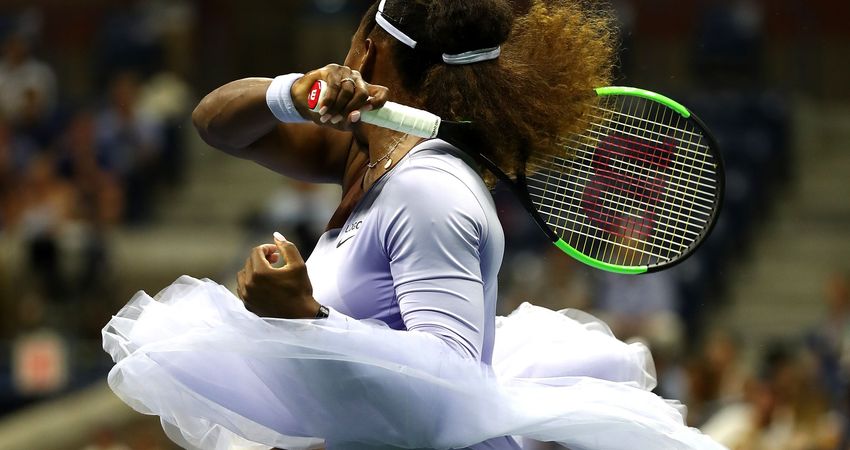
NEW YORK, New York - On Saturday, Serena Williams will play her 31st major final when she takes to Arthur Ashe Stadium for the US Open, two sets away from tying Margaret Court’s all-time record of 24 major singles titles, which Court set 45 years to the day in 1973 when she defeated Evonne Goolagong to win her last major at the US Open.
A win away from what would be a fairytale ending to her first Slam season since becoming a mother nearly 12 months ago, it's important to understand just how astounding Serena's last two months have been. She has now made back-to-back major finals in just her second and third Slams back and her improvement from Slam to Slam has been exponential. She has played lights-out tennis over the New York fortnight, dropping just one set en route to her ninth US Open final.
"Honestly, it is remarkable," Serena said after her 6-3, 6-0 win over Anastasija Sevastova in the semifinals. "I couldn't have predicted this at all. Just been working really hard. Like I said, this is just the beginning of my return. I'm still on the way up."
While Serena looks to rewrite the history books, 20-year-old Naomi Osaka has already put pen to paper on a new chapter for herself. Earlier this spring, Osaka became the first Japanese player to win a Premier Mandatory tournament when she marched to her first title (at any level) in Indian Wells. With her remarkably poised 6-2,6-4 win over 2017 finalist Madison Keys in the semifinals, Osaka became the first Japanese woman to ever make a Slam final and she is bidding to become the first Japanese player, man or woman, to ever win a major.
Born in Osaka, Japan to a Japanese mother and Haitian father, Osaka has made her idol worship of Serena no secret. This summer, at the WTA’s Tennis on the Thames event before Wimbledon, Osaka was asked to name the women who inspire her.
"For me, my mom definitely. My sister. Serena, of course. And Beyonce. In that order," she said then.
In their only meeting, Osaka defeated Serena at the Miami Open this year, 6-3 6-2. "She hit a lot of shots that made me go extremely -- like, I almost fell over," Osaka said after the match. "I was, like, Whoa, that's a Serena shot."
"She's the main reason why I started playing tennis, and I have seen her on TV so many times and I have always been cheering for her, so for me to play against her and just sort of trying to detach myself a little bit from thinking that I'm playing against her and just try to think I'm playing against just a regular opponent was a little bit hard for me."
In fact, Osaka admits that Serena's already in her head. "Sometimes when I am in a really hard position when I'm serving, I'm, like, What Would Serena Do?"
"I feel like they definitely have a lot of respect for me," Serena said after her semifinal win. "I have the same respect.
"However, these young ladies have been playing way longer consistently, so I just feel like they're at a little bit of an advantage. But I have an advantage of I have nothing to lose. I'm going to go out there and do what I can."
Serena is undoubtedly playing at a superior level than she was in Miami, a fact that is not lost on either woman. "It was good that I played her because I kind of know how she plays now," Serena said. "I mean, I was breast-feeding at the time, so it was a totally different situation.
"It was what it was. I mean, hopefully I won't play like that again. I can only go up from that match.
Osaka is a famously shy and reserved personality. She is the first to tell you how awkward she’s feeling in any social interaction. She apologizes profusely when she trips up on her words in an answer, or if she feels she hasn’t answered a question clearly. Say hello to her in the hallways and she’s either shocked at the greeting, as though her invisibility cloak had been pierced, or she reflexively bows her head in deference, whispering a barely audible hello back. Even her coach, Sascha Bajin wasn't sure what to make of her when he first met her.
"I thought she was a little bit more of a diva because she didn't talk much," Bajin said. "She doesn't really look at someone's eyes, but that's just because she was always so shy. She would just keep her head down a little bit, which is cute now. Back then I didn't know for what reason. I feel bad for prejudging."
"What I really love about Naomi is that she really preserved that innocence somehow. So if she's sad, she's gonna show it. If she's happy, she's gonna show it. There are no fake emotions. There is no fakeness or anything like it. It's just very raw, pure emotions."
Osaka speaks softly but carries a big stick. She’s been crushing 120mph serves and blasting huge forehand since she was 16-years-old, yet for all the bombast of her game she seems to revel in the stillness. She’s a known gamer, spending hours playing video games with her older sister. Last year she got into photography, posting scenic photos from her worldwide travels to Instagram. What did she do after she won the biggest title of her career in Indian Wells? She went to the movies to watch Black Panther.
But then there’s the Naomi Osaka on a tennis court. There, on the sport's biggest stages, she has matured into a reliable big-match player. Osaka's early career may have been marked by a number of tough three-set losses, such as her inability to close out Keys in the third round of the 2016 US Open after holding a 5-1 lead in the final set, 2018 has seen Osaka embrace the pressure. She has dropped just 28 games through six matches so far, the fewest games dropped through the first six matches in New York since Serena (26 games) at the 2014 US Open.
"I think the Indian Wells experience has helped me and having this mentality now that I'm ok having this pressure on me," Osaka told WTA Insider ahead of Saturday's final. "I think I'm having more fun now. It's as simple as that."
"I think I've begun to have more confidence in myself, which is a major key. And just knowing that I can win matches because I had never won a tournament before that, so I think that was a really big deal."
On paper, both women come into Saturday's final serving incredibly well. Serena's first serve, the dominant shot in women's tennis, has been locked in from her first match. She's topped it out at 121 mph and struck 64 aces (Osaka has hit 27). When she lands her first serve, Serena has won the point over half the time (Osaka has won 40% of hr 1st serve points).
Where Osaka has had the statistical edge is in the quality of her serve in the clutch. She has won 59% of her 2nd serve points (26% have gone unreturned), compared to Serena's 51% (22% unreturned), and has saved 86% of the break points she's faced (24/28), compared to Serena's 74% (17/23). As a result, the 20-year-old has been broken just four times over the fortnight, winning 92% of her service games (47 of 51). Serena has been broken jus six times, winning 89% of her service games (49 of 55).
On return, both women have identical conversion stats. They have each broken serve 19 times, converting 27 of 46 break points, breaking 53% of the time (27 breaks in 51 return games). Their only differential is in how they go about earning those breaks. Serena has made slightly fewer returns (75%) but has landed 24 return winners. Osaka has relied on her ability to win through the rally, landing 78% of her returns, with just 7 return winners.
This is where the match will turn in both tactics and execution. As much as Osaka has been lauded for her power, she is also perfectly willing to play a more counter-punching style to unwind power.
That was precisely the gameplan she employed against both Keys in the semifinal and Aryna Sabalenka in the Round of 16. Under Bajin, Osaka has learned how to fight her instinct to go for winners and can now defend well into and out of the corners. Keys learned that the hard way on Thursday night, as she tried to blast balls into the forehand and backhand corner, only to get a well-placed response that prolonged the rally and goaded errors.
But Serena has the supreme ability to precisely the same thing. She is moving and defending better in New York than she has all year, giving her far more options. If both are executing well, perhaps the biggest difference will be Serena's superior variety and quality at the net. She has the better slice, the better dropshot, and the better net game. She has gone to the net 70 times this tournament, compared to Osaka's 27. That mindset could tip things Serena's way if things get close.
"For me, when I step onto a court I feel like I'm a different person," Osaka told WTA Insider ahead of the final. "I don't really think of her as Serena. I think of her as another player. I was really fortunate to play her in Miami, so I do feel like I have that experience. I know the crowd is not going to be rooting for me, but I think it's going to be really fun."