




Timing is everything: Rybakina peaks just when it matters at the WTA Finals
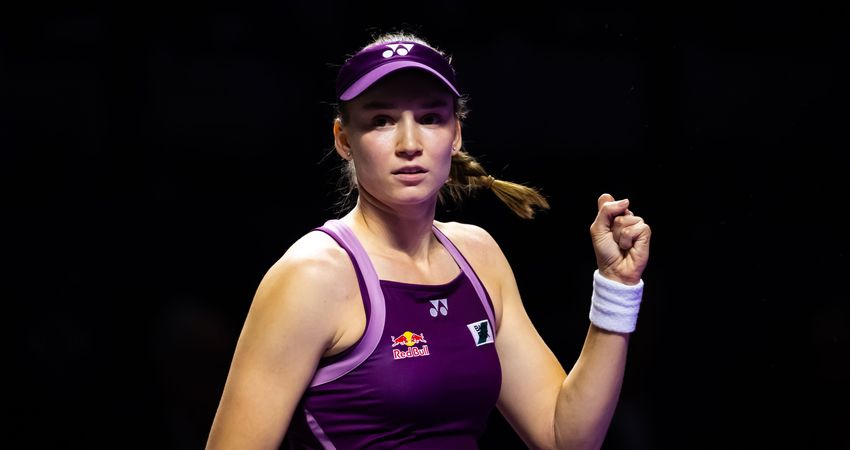
RIYADH, Saudi Arabia -- While the first six singles qualifiers for the WTA Finals were basking in the glory of more than a week off, Elena Rybakina was grinding in Ningbo, China.
Playing with a sense of urgency and absolutely no margin for error, she won all four of her matches there, the title and a crucial 500 ranking points. Then she jumped on a plane and flew 1,000-plus miles to Tokyo, Japan. Rybakina won her first match, then saved a set point and defeated Victoria Mboko in the quarterfinals. That guaranteed her spot at the year-end championships for the third straight season.
Last Friday, after a debilitating 5,000-mile flight to Riyadh, Rybakina met the press. After four events and 11 matches in a span of 29 days, she sounded weary.
“It wasn’t an easy trip, that’s for sure,” Rybakina said. “A bit of jet lag. I had couple days off. I would say, of course, not the freshest, but I think when the competition starts, it doesn’t matter, you try to do your best.
“Yeah, we will see what’s going to happen.”
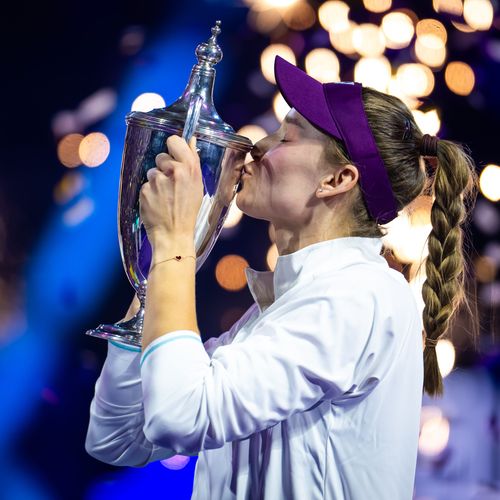
What’s happening, oddly enough, is Rybakina. With impressive wins over No. 2-seeded Iga Swiatek and No. 4 Amanda Anisimova, Rybakina -- the last to qualify for the WTA Finals, became the champion.
That’s not as incongruous as it might initially seem. Actually, the two are intimately connected by a single word: momentum.
The winning streak reached 11 as the 2022 Wimbledon champion capped her season with the WTA Finals title, defeating World No. 1 Aryna Sabalenka 6–3, 7–6 (0) in Saturday’s championship match.
The result closed what had been a curious season for the 26-year-old representing Kazakhstan -- the first time in four years she hadn’t reached a Grand Slam or WTA 1000 final. On the other hand, she was the only player to post double-digit match-wins across the Grand Slams, WTA 1000s and WTA 500s.
“It was a lot of ups and downs throughout the year,” Rybakina said, “but we were trying to improve, even if it’s end of the season. I’m sure if I do well this week, it’s going to be great.”
Riding the wave
Although you can’t see it, momentum is a fundamental concept in physics. The formula:
p = m × v
Momentum (p) is the product of an object’s mass (m) and its velocity (v). The number helps us understand how objects move and interact with each other, especially in scenarios featuring collisions, explosions and other dynamic interactions.
With this late-season surge, Rybakina consistently has been getting the better of her colleagues in a series of dynamic interactions. She’s peaking at precisely the right time. They say that life is all about timing. It’s similar to teams that idle along through the regular season, barely make the playoffs -- then catch fire and go on to win the title.
After losing to Marketa Vondrousova in the fourth round of the US Open, Rybakina found herself last in a three-player race for the last two qualifying spots. Mirra Andreeva, the teenager who won back-to-back WTA 1000s in Dubai and Indian Wells, was in the best shape, ahead of Jasmine Paolini and Rybakina.
After indifferent results in Beijing and Wuhan, Rybakina came to Ningbo as the No. 3 seed -- behind No. 1 Andreeva and No. 2 Paolini. But Andreeva lost to Zhu Lin in her first match and Rybakina dropped a 6-3, 6-2 decision on Paolini in the semifinals.
When Andreeva reportedly couldn’t secure a visa in time to play Tokyo, Paolini qualified and Rybakina won those two matches to join her in Riyadh.
Last year, Coco Gauff won nine of 10 matches in Beijing and Wuhan, then took the title in Riyadh by winning four of five, including a spectacular final over Zheng Qinwen.
Three years ago in Fort Worth, Caroline Garcia rode a hot streak to the WTA Finals championship match, where she bested Aryna Sabalenka. Garcia was ranked No. 35 going into Cincinnati but rallied to qualify and, eventually, won the title. A run to the US Open semifinals gave her 13 wins in 14 matches, the streak that eventually landed her in Texas.
Another way to define momentum -- confidence.
In 2016, Angelique Kerber rode that wave for nearly the entire season. After reaching the final in Brisbane, she won the Australian Open. Later, she got to the Wimbledon final, took the title in Cincinnati, reached the gold-medal match in Rio de Janeiro and won the US Open.
“It’s tough to explain the feeling in words,” said Kerber on Tuesday, sitting in Riyadh’s player lounge. “You have that momentum and you try to take it as long as possible. You are staying in the moment. You are in such a zone. There’s no Plan B, and in your mind, there’s no chance that you lose a match.
“Rybakina, she’s got nothing to lose. We know that when she’s hitting the ball good, she serves well, there’s not a lot of players that can beat her. So the momentum is now, she’s into the semis, let’s see what she can do.”
Confidence is contagious
After a straight-sets win over Anisimova, Rybakina encountered a stubborn Iga Swiatek in her second round-robin match. She had lost all four of this year’s meetings with the 24-year-old from Poland (and eight of nine sets) and again dropped the opener. Then she flipped the pattern -- winning 12 of the next 13 games to take control of her week.
“Very pleased with my serve, and I think the return also got better throughout the match,” Rybakina said afterward. “Whenever it works, I have chances to win against anyone.”
The serve has always been her signature stroke. She led all Hologic WTA Tour players with 480 aces -- more than 100 ahead of Linda Noskova -- averaging 6.5 per match. Indoors in Riyadh, it was nearly untouchable.
For a player who had never advanced past the group stage in two previous appearances, the progress was tangible. And as Ons Jabeur knows, sometimes the end of the year brings its own kind of momentum. In 2022, Jabeur’s spring and summer surge carried her through Charleston, Madrid and Rome before an 11-match winning streak took her to the Wimbledon final -- where she lost to Rybakina.
“Winning gives you confidence — with confidence you dare to do more things on the court,” Jabeur said. “Usually, the one who plays well at the end of the season plays better at the WTA Finals. I’m sure she’s confident, and it’s clear she likes playing on these courts.”
That confidence held. The player who came in last left as champion -- and, fittingly, with her best tennis of the year.