






Top 10 debut sealed: Mboko defeats Ostapenko to make Doha final
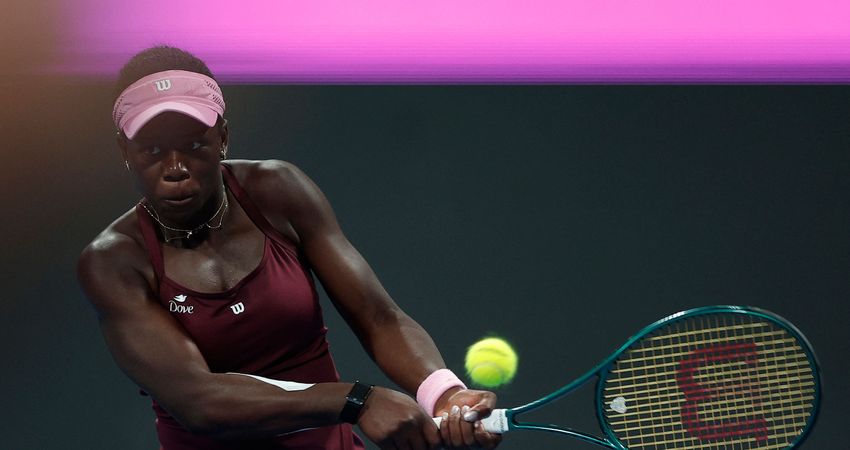
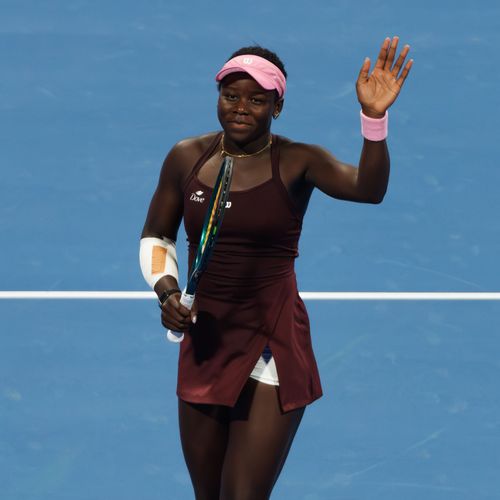
Victoria Mboko's rise isn't slowing down.
The 19-year-old sealed her Top 10 debut next week, along with her second WTA 1000 final, with a 6-3, 6-2 defeat of Jelena Ostapenko at the Qatar TotalEnergies Open.
Doha: Scores | Draws | Order of play
This time last year, Mboko was ranked No. 211, and on the way to collecting her fourth ITF title of 2025 at the Manchester W35 in England. She had played just one WTA main draw in her career, and had yet to win a match at that level.
Just 12 months later, she has two titles on the WTA Tour Driven by Mercedes-Benz under her belt -- Montreal and Hong Kong last year -- and has already reached two finals this season, having been runner-up to Mirra Andreeva in Adelaide. Next week, she will be ranked either No. 9 (if she wins the title) or No. 10 (if she loses to Karolina Muchova in the final) -- becoming just the fourth Canadian woman to be ranked inside the Top 10, following Carling Bassett-Seguso, Eugenie Bouchard and Bianca Andreescu.
"It's kind of crazy," Mboko said afterwards. "I never expected something to happen so fast for me. I just have been taking it day by day, tournament by tournament. Every tournament I enter, I want to do well. I don't really hold that much expectation of myself. It's not like when I enter a tournament I'm going to say I'm going to win it, but you always want to try your best.
"I think this came relatively fast, but it's a nice feeling. It's nice to see that, to have that milestone, to see that number. So, yeah, I'm pretty happy with that."
As for continuing a rise that currently seems unstoppable, Mboko is keeping a level head -- after all, it's worked so far.
"I don't really set goals for myself," she said. "Just because I just like to surprise myself along the way. You never know what's going to happen in tennis. You can have high moments, you can have also low moments. I think just being positive with myself with whatever happens, it's all a part of the process.
"As long as I'm having fun doing what I love, it's going to pay off at the end of the day and, who knows, maybe good things may come my way in the future."
FINAL BOUND! 👏
— wta (@WTA) February 13, 2026
Vicky Mboko books her spot in the Doha final advancing in straight sets against Ostapenko!#QatarTotalEnergiesOpen pic.twitter.com/BF4fJWCG4h
How did Mboko pass the Ostapenko challenge?
Perhaps the most impressive aspect of Mboko's game is her sheer all-round adaptability. In her past three wins, she's shown herself capable of executing different game plans against opponents who presented disparate challenges.
When Andreeva dragged Mboko into lengthy rallies and threw all manner of spins and angles at her, Mboko held her ground with supreme rally tolerance and creativity of her own. Facing Australian Open champion Rybakina's formidable serve, Mboko's own delivery proved steadfast.
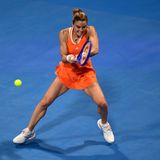
Against Ostapenko, lengthy rallies and routine service holds were not on the cards. Instead, it was a question of weathering the storm of the Latvian's best winners, stepping up the aggression on return and finding her own first strikes.
Mboko did all the above superbly. She withstood two Ostapenko purple patches -- firstly at the start of the match, when the former Roland Garros champion blitzed the first six straight points with some breathtaking hitting, then again at its close as Ostapenko attempted to fight back from 5-0 down.
In between, Mboko found a number of tactics that paid dividends. On return, instead of going for outright winners, she jammed Ostapenko at the baseline with hard, deep strikes that routinely drew errors on key points. She was prepared to pull out drop shots and redirected backhands in the first few shots of a rally rather than playing a safer game. And her retrieving skills lured Ostapenko into over-pressing time and again, particularly in the rapid-fire five-game run to Mboko at the start of the second set.
"She was playing really great tennis at the start, so I felt like I had to step it up," Mboko said in her on-court interview.
Mboko tallied an even 15 winners (including six aces) to 15 unforced errors, while Ostapenko's 22 winners were outweighed by 27 unforced errors.