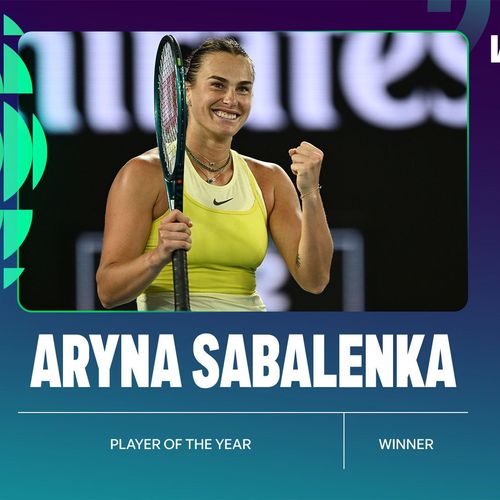




Insatiable work ethic is the 'X-factor' powering Aryna Sabalenka's dominance
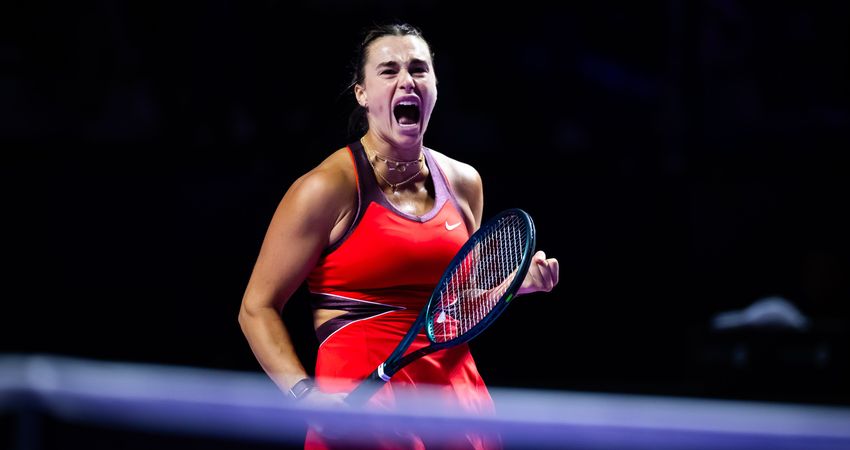
Do not be fooled by the steady stream of Aryna Sabalenka’s beguiling Instagram posts from the Maldives or those stylish pics for Vogue Arabia.
For as we speak, she’s already back in the gym, pumping some serious iron and sweating through those gut-wrenching agility drills.
As effortless as it sometimes appears on court, maintaining the World No. 1 ranking for 60-plus consecutive weeks is more about what we can’t see -- putting in the work, doing the hard yards.
According to her team, it’s the biggest X-factor behind Sabalenka’s choice as the 2025 WTA Player of the Year.
Jason Stacy, her performance/fitness coach, says her work ethic is insatiable. Even on the days when she isn’t feeling her best, even when her team suggests a day or two off, Sabalenka pushes through.
“She’s like, `No, no, I’m doing the workout,’ ” Stacy said at the WTA Finals. “She might complain about it, might not really want to do it sometimes, but she’ll always still do it.
“She has that drive in her, so we actually have to come in and manage it a little bit.”
Angelique Kerber, a three-time Grand Slam champion known for her strength and tenacity, has noticed.
“The routine is definitely working,” she said recently. “She’s so strong physically. And that strength gives her confidence. And confidence is mental strength.
“It’s a tough combination to beat.”
Two telling examples from the WTA Finals last month:
· Serving for the first set in her final group match against Jasmine Paolini, Sabalenka dropped the first two points -- and responded by hitting four aces in the next five points. She won the match going away, 6-3, 6-2.
· In the semifinals, Amanda Anisimova was in position to take the critical first set, forging five break points. Sabalenka won them all and -- after saving 14 of 18 break points for the match -- won a thriller in three sets, ending the American’s streak of 13 straight three-set victories.
Sabalenka lost the season’s first two Grand Slam finals -- falling to Madison Keys in Melbourne and Coco Gauff in Paris -- devastating losses that might have done irreversible damage to some players. Sabalenka rallied to win the US Open, collecting the fourth major title of her career, and reached the championship match of the WTA Finals.
In the frothy sea of statistics generated across more than 10 months of global play, this might be the best: Sabalenka made the finals in four of the five most important tournaments.
And while Sabalenka was initially disappointed with how she finished at the year-end championships, she finished with the most titles (four), finals (nine), ranking points (10,870) and the most prize money in women’s tennis history -- $15,008,519.
At 27, Sabalenka has largely solved the issue that sometimes short-circuited her early career -- control of her emotions -- but it creeps in from time to time. The Australian Open and French Open finals were stark examples of Sabalenka losing her composure in the most important moments.
Anton Dubrov, Sabalenka’s tactical coach, said there were no pointed, difficult conversations afterward.
“Just honest discussions,” Dubrov explained. “What you want is here [holding out his right hand]; what you experienced right now is here [left hand]. There’s this gap between the two and trying to work on it. She’s trying to work on it. She’s more honest about it. I like this.
“Even after Paris, she was open to talk about it, like `Yeah, I was wrong, this is my mistake. We are all humans. What’s next?’ Not everybody is like Roger Federer, always perfect all the time.”
Sabalenka first ascended to the No. 1 ranking in the fall of the 2023 season. Iga Swiatek took it back eight weeks later by winning the WTA Finals in Cancun. Sabalenka, on the strength of bookend major victories, regained the top spot 13 months ago and has yet to relinquish it.
“First time she was No. 1, she didn’t know what to expect,” Dubrov said. “Second time, she was, `OK, I’ve been there before. I want to sustain this and be consistent.’ She was more humble and motivated to not only stay longer but to show why she is No. 1."
Added Stacy, “She took more responsibility for it. She understood the importance of the position -- not just for herself but for the team. Much more professional, much more mature.
“I think having that legacy, this wanting people to look back at her, look up to her, saying, `Look how she carried herself, how she held up to this,’ … pretty cool.”
Ons Jabeur -- a winner over Sabalenka in two of their three Grand Slam meetings -- was asked in Riyadh to explain why Sabalenka is so successful. Her answer was succinct, capturing the Sabalenka conundrum that again makes her the player to beat in 2026.
“The way she hits the ball, the power that she has -- her serve,” Jabeur said. “She puts a lot of pressure on the player.
“If you give her an easy ball, you’re going to pay the price. Or … you’re scared to give her an easy ball -- and you miss.”
That pressure doesn’t come from a single shot. It’s built through repetition.
“At this point, it’s just 1% at a time,” Sabalenka said. “You work a little bit on something, get a little bit better — and it’s already a huge benefit.”