







Svitolina, Kostyuk extend Ukrainian winning streaks at Roland Garros
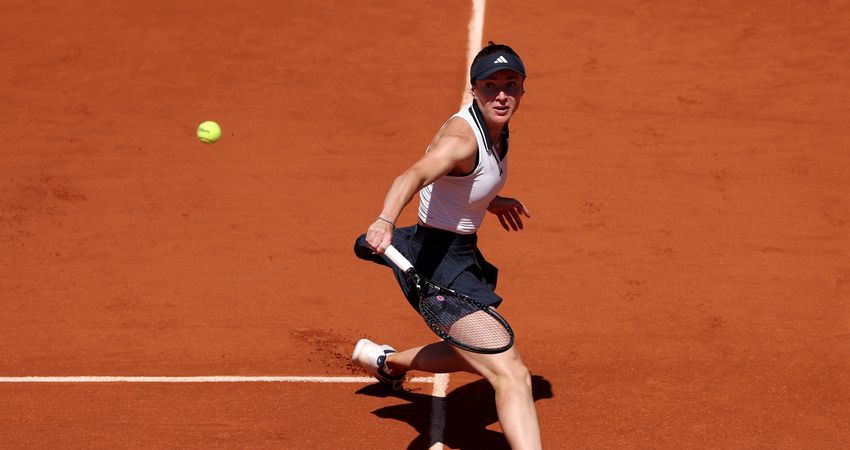
The Ukrainian surge at Roland Garros continued on Wednesday, as both Elina Svitolina and Marta Kostyuk extended their winning streaks with second-round wins.
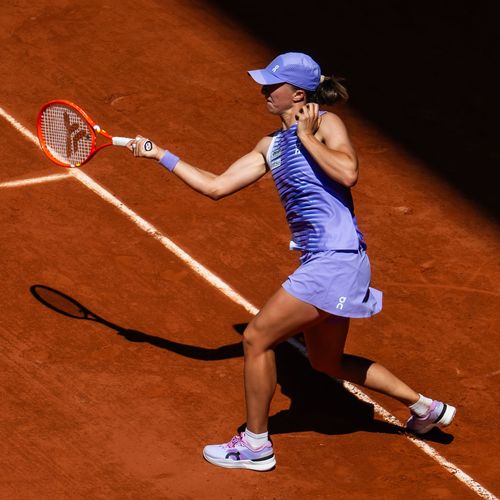
Rome champion Svitolina has now won eight straight after defeating qualifier Kaitlin Quevedo 6-0, 6-4. Rouen and Madrid champion Kostyuk had to work harder to extend her streak to a career-best 14 in a row, finally quelling Katie Volynets' challenge 6-7(4), 6-3, 6-3 in 2 hours and 43 minutes. Kostyuk advanced to the third round in Paris for the first time since making the 2021 last 16.
One straightforward set, one tough one for Svitolina against rising 20-year-old
After battling through a deciding tiebreak against Anna Bondar in the first round -- her fourth consecutive three-setter, including her last three rounds in Rome -- the No. 7 seed felt she was battle-hardened, but happy to have escaped Quevedo in straight sets.
"[A three-setter] puts you directly into fighting mode and tournament mindset," she told former No. 4 Caroline Garcia in her on-court interview. "But it's nice to get a two-set win today."
Quevedo, 20, was on a winning streak of her own, albeit at a lower level than Svitolina. The Spaniard had not lost between Madrid -- where, as a home wild card, she defeated Venus Williams to notch her first WTA 1000 victory -- and the second round in Paris. Her nine consecutive wins encompassed the Saint-Gaudens ITF W75 title, then successfully qualifying for her Grand Slam main-draw debut and defeating Leolia Jeanjean in the first round.
That run had pushed Quevedo to a career high of No. 126 this week. But she had never faced a Top 30 opponent prior to Svitolina on Wednesday, and in the first set it showed. She tallied just one winner to 12 unforced errors as she struggled to find a way past Svitolina. Meanwhile, the Ukrainian won 91% of her first-serve points en route to her second 6-0 set of the season so far.
Down a set and a break at 2-1, Quevedo began to show off her best tennis. She broke back with a series of superb forehand winners, and pushed Svitolina hard as the rallies lengthened and the games became more tightly contested.
But ultimately, few can elevate their level when they need to like Svitolina. As Quevedo held a game point to reach 5-4, the four-time major semifinalist came up with a sumptuously angled drop volley. She continued to come forward, taking that crucial game with a powerrful drive volley winner and then a rinse-and-repeat drop volley on break point.
"In the first set I was playing really well, and of course you expect your opponent to step up their game," Svitolina said. "I was very happy the way that I could stay strong and brave at 4-4 -- it was a really tough game -- then serve it out nicely."
Svitolina will next face Tamara Korpatsch for the first time. The 95th-ranked German came through an entertaining 6-2, 2-6, 6-3 tussle to defeat No. 32 seed Wang Xinyu and move into the third round of a major for the first time in her career. Korpatsch is competing in her 12th Grand Slam main draw, and had previously lost in the second round on four occasions. Having reached her second career WTA final in February in Ostrava, she has now notched three Top 50 wins in a single season for the first time as well.
The 31-year-old's footspeed shone as she soaked up Wang's heaviest blows and tracked down the Chinese player's drop shots. There was some tension throughout the match: Wang objected to the umpire calling her forehand long on the penultimate point of the first set, and did not shake hands with Korpatsch.
Kostyuk survives torrid battle against Volynets
Though Volynets' ranking is at No. 108 this week, some way down from the career high of No. 56 that she set in 2024, the American's speed and counterpunching skills made her a potential banana skin for Kostyuk -- whom she had also defeated 7-5, 6-3 in the 2024 Beijing first round, their only prior meeting.
Over nearly three hours, Volynets -- who also has Ukrainian heritage, and is fluent in the language -- proved that she is still one of the toughest competitors on the WTA Tour Driven by Mercedes-Benz, adept at seizing opportunities and withstanding the barrage of 60 winners from Kostyuk's racquet.
For much of the first set, No. 15 seed Kostyuk was a walking highlight reel. There was a screaming backhand pass to break for 2-1, an exquisite drop volley to level at 3-3, and at 5-4 she advanced to triple set point courtesy of a flashy double-volley combination and a sharply angled pass.
But Volynets was nevertheless able to stick with Kostyuk on the scoreboard. She briefly went up a break thanks to a fine sequence of forehands, then escaped all three set points with two unreturned serves and a stroke of luck with a dead net cord.
Kostyuk's inability to convert led to a dip in her form. Errors and misjudgments began to flow as she conceded her serve at 5-5. Even when Volynets threw in a pair of cheap backhand mistakes of her own as she failed to serve the set out, Kostyuk was unable to take advantage in the ensuing tiebreak.
Volynets was inches away from going up a set and 2-0 after Kostyuk double faulted to go down break point. But if a twist of fate had turned the first set around with the net cord, another one came to Kostyuk's rescue here: her backhand down break point, initially called out, was overruled as a winner by the umpire after the mark on the clay showed it in.
After escaping with the hold, Kostyuk's form settled down again. Most noticeably, the effectiveness of her second serve improved: having won just 39% of those points in the first set, she came away with 62% in the second. Closing it out was still not straightforward -- having advanced to a 5-1 lead, she was unable to serve it out at the first time of asking and required five set points to get over the line. But a fine backhand return eventually sent the match to a decider.
Kostyuk played her most authoritative tennis of the match in the third set. Her serving continued to improve -- she only dropped four points behind her first serve and five behind her second, and saved the only break point she faced with a backhand pass in the final game. A gorgeous combination of a sliced backhand to set up a flat forehand winner, both landing in the corners of the court, was another addition to her highlight reel. And despite Volynets again keeping the scoreboard close, Kostyuk stepped her return game up at the perfect moment, finding another series of backhand winners to break for 5-3.
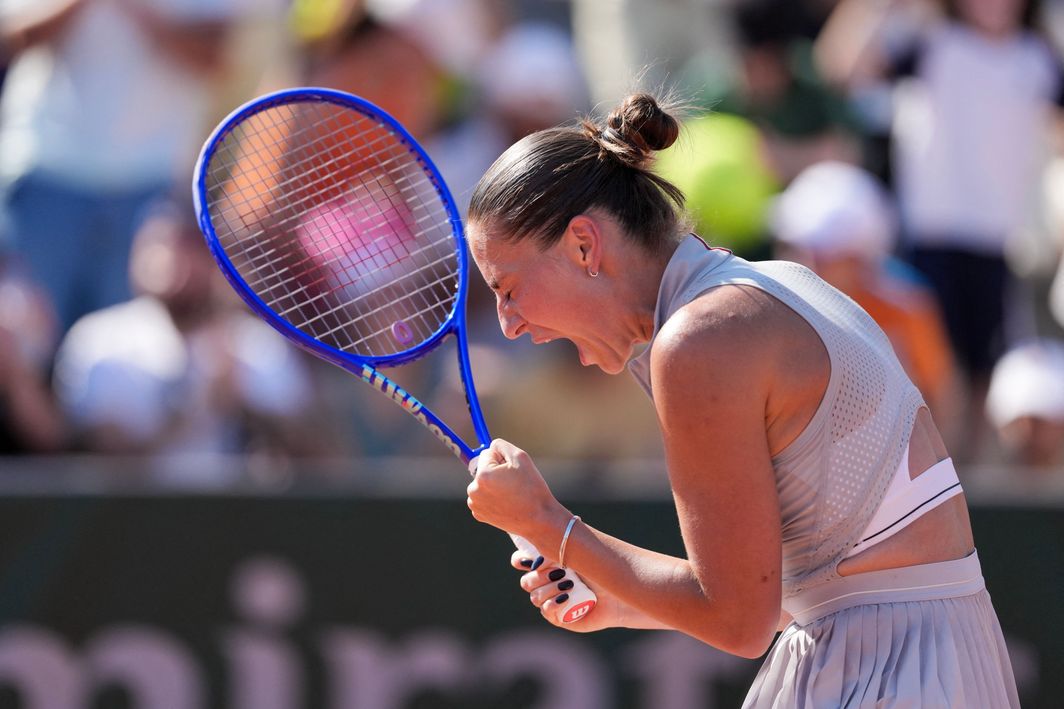
Kostyuk converted her second match point with a simple one-two punch, but the roar of delight she let out indicated just how much of a test she'd had to pass. Next up will be former Wimbledon quarterfinalist Viktorija Golubic, who advanced to the third round of Roland Garros for the first time in her career at the age of 33 with a 6-2, 6-2 defeat of Alycia Parks in just 63 minutes.
Afterwards, Kostyuk said that the hot conditions had been the most important factor in the match going the distance.
"I think I'm most pleased that I didn't cramp to death or didn't pass out during this match," she said in her press conference. "I think it didn't help me today that I played first match first, because it was way, way cooler. But, yeah, it was not easy. I needed to adapt. I needed time. Was very unlucky on set points in the first set. I think if I won that first set, it would have ended in two. I mean, I'm hoping it would be like this. That didn't help. But I still think it was really good match. I think she played very good today."
Kostyuk turns to mental economy training following Melbourne loss
It's not the first time that Kostyuk has come into a Slam in top form this year. In Australia, she took down three Top 10 opponents to reach the Brisbane final -- only to crash out in the first round of the Australian Open to Elsa Jacquemot in a 3-hour, 31-minute triple-tiebreak epic, still the longest tour-level match of 2026 so far.
After that loss from match point up, Kostyuk's osteopath Claudio Zimaglia gave her a home truth -- and a recommendation.
"It was very difficult message that he sent after I lost in Melbourne first round and I got injured," Kostyuk recalled. "He said, 'Yeah, your mind was not in the right place ... you need to work on that. He didn't say it in that way. He was just texting on the group, saying, 'Yeah, I think there are things that can be improved, and it wasn't good at all.' He introduced us to this mental economy training, and I have been doing that since then. It's super cool."
Mental economy training is the brainchild of former Formula 1 doctor Riccardo Ceccarelli, and comprises a system of mental exercises designed to improve an athlete's self-awareness of how their brain works in different situations. He offers a "mental gym" at the Piatti Tennis Center in Bordighera, and ATP No. 1 Jannik Sinner is another player who's used it.
"It doesn't work for everyone," Kostyuk said. "We have spoken with them a lot, and they're like, 'Yeah, there are some players who are unbelievable at this, but they just go on court and nothing -- like, it's gone.'
"But I'm happy with the work we've done. I don't know exactly what has changed, because I didn't do also that much. But I think the biggest difference that I see is that I care way less on the court, and I don't spend too much of my brain energy on things. I just let it go faster. And I know the feeling that I have when I practice this thing, when I don't use my brain energy, and I'm trying to find that feeling.
"So that helps me to not burn out, you know, or to be exhausted after long matches or whatever."