



The headline from the last Grand Slam of the season was clear: Elena Rybakina was now a three-time Grand Slam champion after winning her first US Open, and a World No. 1 for the first time. With the title, she also became the first player to qualify for the year-end WTA Finals.
But in the lead-up to Rybakina's trifecta of excellence, many unique storylines and angles developed, as they tend to do over the course of two hectic weeks.
Though Rybakina's title and rise to the top will be most remembered from the US Open, and deservedly so, these five stories are also worth remembering.
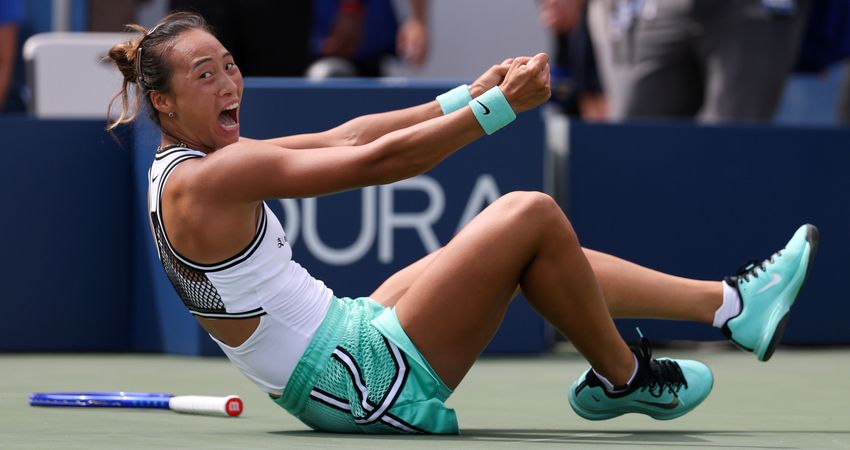
Zheng Qinwen's resurgence
Zheng Qinwen came into the US Open with very little momentum and very little fanfare. In fact, having fallen to No. 121 in the PIF WTA Rankings, she had to qualify for the main draw for the first time.
With a residency on Court 17, the bright lights of nearby Arthur Ashe Stadium not even a flicker in her mind at that point, Zheng won three straight matches to qualify, the last of which was a three-setter.
Three more three-set wins would follow, the last of which was a comeback from 5-0 down in the decider against Madison Keys. That victory, arguably the most stunning comeback of the WTA Tour Driven by Mercedes-Benz season, sent her back to Arthur Ashe Stadium, to play former champion Iga Swiatek.
Zheng fell behind 5-0 for the second consecutive set before pulling off another escape, winning seven straight games to take the opener. She went on to upset eighth-seeded Swiatek in straight sets to reach the quarterfinals, becoming just the second US Open qualifier to do so.
Rybakina ended her run in three sets, but not before Zheng reminded us that she's still one of the fiercest competitors and hardest outs on tour. Her seven wins in New York propelled her 69 spots in the PIF WTA Rankings, to No. 52.
Taylor Townsend finds best form and best self -- then makes history
Taylor Townsend was vibing throughout the tournament. Her on-court interviews -- honest, raw and hilarious -- were must-see TV (must-see YouTube watches?), and she seemed to have an extra spring in her step in her custom US Open kit, created by celebrity stylist J. Bolin.
The vibe translated on court, where she reached the fourth round in singles for the second straight year, knocking off seeds Maja Chwalinska and Diana Shnaider in the process.
Though her run came to an end against top-seeded Aryna Sabalenka, she didn't let that detract from her doubles performance. Townsend and Katerina Siniakova, the top seeds, won six matches to win the US Open and complete the career Grand Slam together. (For Siniakova, it was her second Grand Slam after first achieving it with Barbora Krejcikova.)
After the title, Townsend celebrated, appropriately, with a couple of Honey Deuces.
Emma Navarro gets her groove back
Coming into the US Open, Emma Navarro hadn't gotten past the fourth round in her previous six majors, and only reached the Round of 16 once during that span. She has steadily declined in the rankings after reaching the Top 10 in 2024, nearly falling out of the Top 40 before winning the title in in Strasbourg in May.
A strong result in New York felt needed, and she delivered, getting to the final eight for the first time in two years. In doing so, she upset Wimbledon finalist Karolina Muchova and 21st seed Anna Kalinskaya, setting up an All-American clash with Jessica Pegula. She took the first set with ease, before Pegula rallied to take the next two.
All in all a strong and encouraging US Open for Navarro, who returns to the Top 25.
From the big screen to the Grandstand
You are forgiven if you didn't pay too much attention to Rybakina's routine 6-3, 6-2 first-round win in the Grandstand. Her opponent, though, entered her first US Open with quite the unorthodox backstory.
Thea Frodin, 17, played Serena Williams' tennis double in the Oscar-winning film "King Richard" five years prior, when she was 12. Frodin secured the dream role after sweeping the singles, doubles and mixed doubles titles at a 10-and-under sectional tournament in California. The film's producers took notice, asked her to audition and the rest is history.
Cut to the present day, and another title led to a bucket-list opportunity for Frodin. The Southern California native won the singles title at the USTA Billie Jean King Girls' 18s National Championships two weeks prior to the US Open, earning her a wild card and a spot across the net from Rybakina.
Frodin showed promise, and plenty of poise, in her Grand Slam debut, taking five games and making Rybakina work for her points.
Luckily that wasn't the last that fans would see of Frodin in New York. She played the junior girls' tournament six days later, dropping her first-round match to Katerina Zajickova in three sets.
We're sure we'll be seeing Frodin in Queens, and everywhere else, for many years to come.
Clutch and consistent at the top
Much has been made of the WTA Tour's remarkable depth and parity, and that has been proven by the variety of champions this season, seedings and rankings (and nationalities) be damned. There is a healthy mix of established champions, rising stars, steady veterans and talented up-and-comers.
There were plenty of upsets and three-set thrillers at the US Open, but much credit must be given to the top seeds, who survived and advanced in the face of great expectations, and with targets on their backs.
Six of the top eight seeds made the US Open quarterfinals -- Navarro and Zheng were the other two -- for the first time since 1998. And the top four seeds -- Sabalenka, Rybakina, Pegula and Coco Gauff -- reached the semis for the first time since 1975.
It's especially impressive considering how much was at stake for the top four. Yes, there are always tremendous stakes at Slams, but in this particular case, all four players had the chance to be World No. 1 by the end of the tournament. That pressure didn't derail them. They all rose to the occasion, separating themselves from the field. It's a testament to their steadiness, consistency and clutch play.