





What Zheng Qinwen learned from the year she had to stop and heal
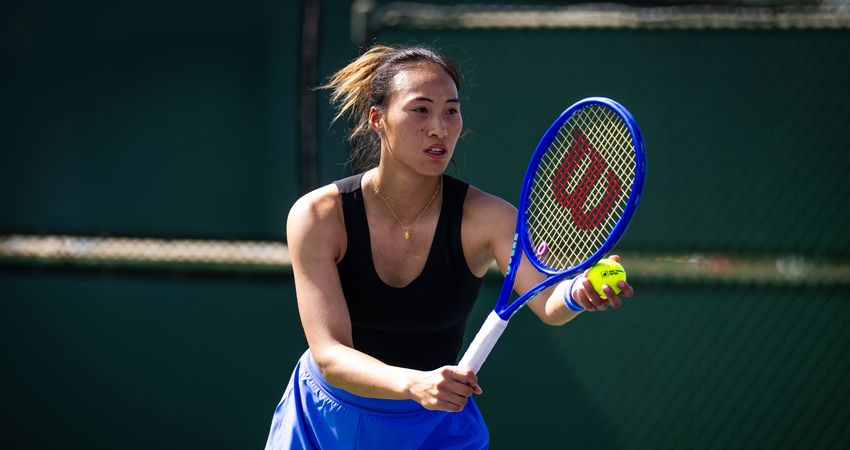
INDIAN WELLS -- After an entire year of suffering chronic pain in her right elbow, Zheng Qinwen was finally driven to undergo surgery last summer. But six months later, when it was clear she still wasn’t ready to go for this year’s Australian Open, she locked herself away and sobbed.
“I really hoped that I can play,” Zheng told wtatennis.com on Tuesday. “Actually, when me and my team decided together we couldn’t go, I was crying a lot in the bathroom. The doctor, the physio, they can tell me their opinion, but at the end I’m the only one who knows what I’m feeling.
“I know now that I have to listen to my body.”
It was a hard lesson learned for the 23-year-old from China.
The leading storylines at the BNP Paribas Open include Aryna Sabalenka’s sustained, 72-week run as world No.1, the challenge of reigning Australian Open champion Elena Rybakina and the emergence of a handful of young and exciting players.
But perhaps the most tantalizing question concerning the WTA Tour Driven by Mercedes-Benz is: What, really, to expect from Zheng Qinwen?
She’s played only five matches in the more than eight months since last year’s Wimbledon, and Saturday the No. 24 seed meets the winner of Thursday’s first-round match between Antonia Ruzic and wild card Jennifer Brady.
What makes Zheng’s prospects so exciting? The spectacular burst she displayed in 2024, when she marked herself as a true phenomenon at the age of 21.
In a blur of unreturnable serves and forehands, Zheng won the title in Palermo, the Olympic singles gold at Roland Garros (beating four-time champion Iga Swiatek in the semifinals), reached the quarterfinals at the US Open, the semifinals in Beijing and the final in Wuhan before winning another title in Tokyo and advancing to the championship final at the WTA Finals in Riyadh.
All told, Zheng won 28 of 32 matches, losing to Coco Gauff in a charged Riyadh final -- in a third-set tiebreak.
“For me, I always feel so wonderful and incredible to be the Olympic champion -- because that’s the biggest title I will ever win in my life,” Zheng explained. “And I created a new history for Chinese tennis.
"The season of 2024 brings me a lot of experience that I have to get better and improve and keep getting better."
The pain actually began three days before 2024 Wimbledon. Medication failed to dull it, but she persisted.
“I find a way to keep competing,” Zheng said. “I was the Olympic champion, but I don’t want to stop, I want to keep going, yes. I want to reach the WTA Finals for the first time -- and I made it.
“And after, I tried to keep going but arriving in 2025 my body is telling me you need to stop.”
The injury, Zheng said, was not typical of a tennis player, not an inflamed tendon or ligament. Rather it was small piece of bone floating in the elbow due to years of thumping the ball with authority that demanded an arthroscopic procedure.
Zheng rehabbed diligently, but three months after surgery wasn’t sure she was ready to return. But when her doctor cleared her to play, she gave it a go in Beijing, retiring in the third set of her second match against Linda Noskova.
“At the end,” Zheng said. “We jump -- and I was hurting even more. And suddenly, arrived one moment where I said, `I don’t think I can hold this pain anymore.’
“And we went to do an MRI and there was a lot of liquid again in the elbow. And then we know, 'OK, time to stop.’”
In retrospect, she believes the decision to come back too quickly may have cost her this year’s Australian Open -- and a number of tearful episodes.
The terrific news? Zheng said she’s pain-free and feeling good after winning two of three matches in Doha, losing to the red-hot Rybakina in three sets.
Zheng confirmed this Tuesday after a series of Media Day interviews in the cozy confines of Interview Room 3.
“Yeah, quite positive three matches,” she said. “I had a great serve [in Doha]. I think great competition. Long time I didn’t jump in the competition, there was some ups and downs during the match. But I will say overall, I’m quite OK.
“Of course, I always think I can do it better, but let’s see the rest of the season in 2026.”
The possibilities are myriad, and this thought occurs: If Zheng can dominate with a serious injury, what can she do at full strength? Her goals, she insisted, are not specific to results.
“My goal right now is to keep my body healthy, because I know when I’m healthy, I can reach anything that I want,” Zheng said. “But first of all, I need to be healthy -- that’s my priority. And the rest, I keep working hard, keep my competitive mind and the rest will come along.”
Wim Fissette currently coaches Iga Swiatek, but he worked with Zheng briefly in 2023. He was asked Wednesday just how good Zheng could be.
“She could be world’s best,” Fissette said, “but the body is, of course, is the key. Yes, she has been with some injuries.
Qinwen is a player that really works for it. She’s very tough on herself. She will do literally whatever it takes. She played through pain, she doesn’t want to retire in matches.
“She has a clear dream of winning a Slam and becoming No. 1. She will not stop working hard until she achieves that.”
Zheng is a free spirit, who says what’s on her mind and is always unabashedly self-deprecating. It’s instructive that as a young girl she was a talented table tennis player, especially in doubles. In retrospect, she said, the sport was too confining.
It’s an attitude that colors her as a champion.
“I didn’t really like table tennis, because the court is too small for me,” Zheng said, smiling. “It’s like too fast and too small.
“Tennis, the ball is bouncing, the court is bigger, I can run more -- it’s much more fun. And winning is on you, losing is on you. You don’t blame your partner, because there is no partner -- and I love that.”