







Evert, Navratilova reflect with clarity and honesty in 'Chris & Martina: The Final Set'
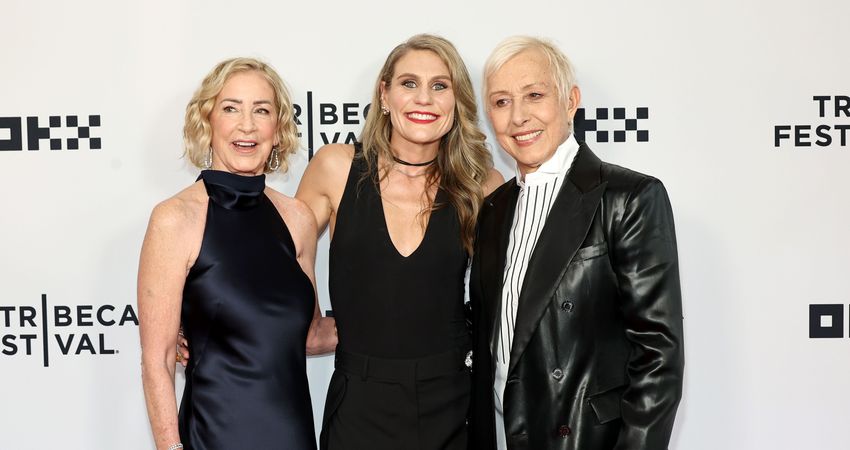
Back in 2010, very early in her career, Rebecca Gitlitz had the opportunity to serve as a coordinating producer on a 30 for 30 episode about Chris Evert and Martina Navratilova, on ESPN.
Many high-profile projects ensued over the next 13 years, many of them in sports (and specifically women's sports), plus a couple of Emmy Awards.
Then in 2023, a Washington Post article by Sally Jenkins about Evert and Navratilova's longstanding rivalry and shared cancer battle caught Gitlitz's attention, and she knew there was a new story to tell about the WTA Tour Driven by Mercedes-Benz icons.
"When people have cancer, and they have that perspective shift, it seems like there is that one golden opportunity to get that moment of clarity and honesty," the New York-based filmmaker said. "And I wanted to hop on it."
Gitlitz got the 18-time Grand Slam champions on the phone and mapped out her vision.
"I said, 'If you guys are willing to be honest, and you want to trust me, I want to trust you,'" Gitlitz said. "Let's go on this ride together. And that's what we did."
The result, three years later, was Chris & Martina: The Final Set, a critically acclaimed documentary that premiered at the Tribeca Film Festival earlier this month and will be available on Netflix on June 26.
Containing never-before-seen footage and rare interviews, the documentary examines their decades-long rivalry, which included 80 career matches and 60 finals. They were the ultimate contrast in personalities and styles -- the All-American Evert, from Florida, and Navratilova, who defected from communist Czechoslovakia. It starts in the early 70s, when Evert had the clear upper hand in the rivalry, and works its way through the 80s, when Navratilova changed her mindset and improved her fitness to catch up.
They are also seen rewatching some of their classic matches together for the first time, emotionally reliving some of the most seminal -- and in some cases, heartbreaking -- moments of their careers, and lives.
"I wanted them to talk to each other, rather than hearing outside perspectives," Gitlitz said. "We've heard that forever. And they're funny, because they'll be like, 'Oh, I forgot.' But when you push it, they don't forget anything. They remember point by point. And as we got further, I would poke them a little bit further. I wanted to unpack the wounds a little bit more."
The tennis footage is expertly juxtaposed with their current-day cancer treatments, and their unyielding support for each other in the face of darkness.
During filming, Evert's ovarian cancer returned -- there was a 90 percent chance that it wouldn't -- forcing Gitlitz to pivot. As Evert's perspective shifted, so did the film.
"We followed her second journey," Gitlitz explained, "which was extremely brave of her to let us do. What we got was a very stripped-down Chrissie. We waited, and we were patient until she was ready. As Chrissie got further through treatment, she got a little bit more vulnerable. She got a little bit more therapized, in her own words.
"And so we were able to go deeper. We stayed on their comfort-level path, but I did push to allow a deeper path that they were willing to go on, but not willing to initiate."
If the tennis scenes were fun and exciting to piece together, the scenes at Memorial Sloan Kettering and the Cleveland Clinic -- where Navratilova and Evert received treatment -- were the exact opposite. They were difficult and uncomfortable, but both tennis legends were willing to go all-in to share their experiences, and to bring to light the importance of early screening and detection.
Gitlitz was clear that if they wanted her to stop filming, if it got too raw and uncomfortable, she would, no questions asked. But both Evert and Navratilova stayed true to their word that they wanted their full story told, from every angle and vantage point.
"They did their cancer the way they did tennis," Gitlitz observed. "They are just really legendary human beings. They are everything you think they are going to be, and more. And that doesn't mean it was always pleasant. They are ruthless, and I mean that in the best possible way. That's what it takes to be legendary."
Evert and Navratilova's commitment to baring everything in the face of unspeakable obstacles further drove Gitlitz to make the most impactful documentary she could, and to do their remarkable rivalry, journey and friendship justice.
"We would go back to the edit," she said, "and I'd be like, 'We are gonna work for 24 hours.' I don't care what it takes. They deserve the film that they put in the work for."
Just as Evert and Navratilova made sacrifices in their respective health battles, they also made tremendous sacrifices in their pursuit to be the best in the world, a thread that Gitlitz was passionate about documenting.
Navratilova left her family, her friends and her homeland, and had to deal with the stress and anxiety of not being the fan favorite and golden girl that Evert was perceived to be. She also had to deal with the speculation about her sexual orientation from a questioning and hovering press.
Evert, meanwhile, essentially gave up her social life in her quest to become No. 1, at one point admitting that she cried after winning Wimbledon because she realized she didn't have any friends. (We learn in the documentary that Evert and Navratilova were friends early on in their careers, and in fact teamed up to win two doubles Grand Slams, but Evert ended their partnership because she feared that Navratilova was becoming too familiar with her game.)
The sacrifices that World No. 1s make, especially women, is not fully understood or appreciated, Gitlitz said, and in their case it helped revolutionize tennis -- and women's sports.
"They carried the game," Gitlitz said. "Women's sports would be nowhere close to where it is today without those two. And I hope that people understand what they gave us, because I don't know that there is that level of understanding. I hope, first and foremost, that people understand what a cultural shift they gave us."