




Sabalenka passes Ostapenko test at Wimbledon; sets Osaka meeting next
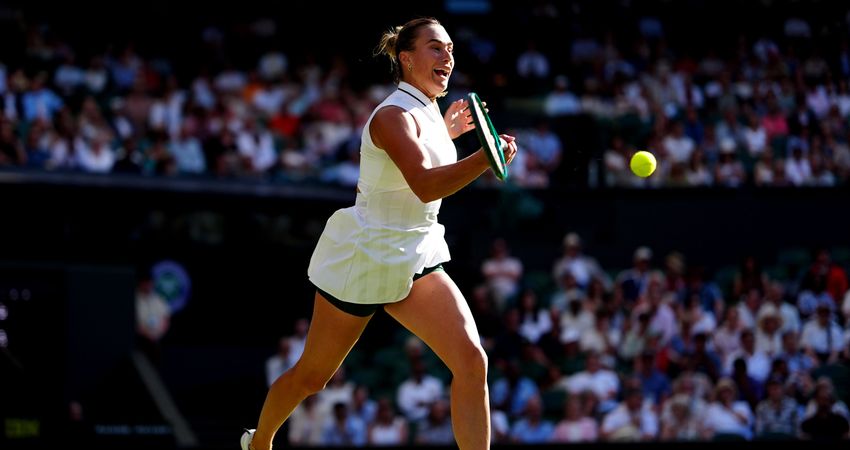
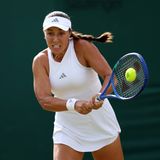
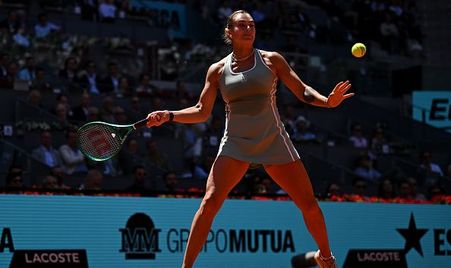
No. 1 seed Aryna Sabalenka navigated a tricky third round in style to reach the second week of Wimbledon for the fourth time, defeating Jelena Ostapenko 6-4, 6-4 in 1 hour and 32 minutes, holding off a late charge by the former Roland Garros champion from 4-1 down in the second set.
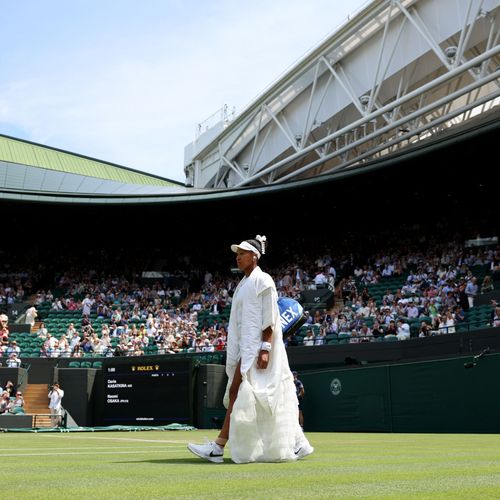
Sabalenka has now reached the second week of the last 15 Slams that she has contested dating back to Wimbledon 2021, and 20 times in total. She'll face fellow four-time major champion and No. 14 seed Naomi Osaka on Sunday for the fifth time, fourth time this year, and first time on grass -- and, oddly, for the fifth time in the fourth round of a tournament. Though Osaka won their first encounter at the 2018 US Open 6-3, 2-6, 6-4, eight years on Sabalenka has gained the upper hand. The World No. 1 has conceded just one set in three meetings in Indian Wells, Madrid and Roland Garros.
What were the keys to Sabalenka's win?
The meeting between Sabalenka and Ostapenko, two of the biggest hitters on tour, delivered as expected on the aggression front: the pair combined for 46 winners, 19 from Sabalenka and 27 from Ostapenko. In both cases, that outweighed their unforced error count -- Ostapenko committed 18, while Sabalenka kept hers to a meagre six.
But the top seed's serve gave her the edge in most of the match's most important moments. She led the numbers in every service statistic: nine aces to Ostapenko's four, 71% of first-serve points won to 63% and 50% of second-serve points won to 47%. The match teetered on a knife edge until the final game -- which, from 30-30, Sabalenka wrapped up with consecutive unreturned deliveries.
Indeed, Sabalenka excelled whenever the games got tight. Ten games featured at least one 30-30 or deuce tipping point, and Sabalenka won seven of them -- four out of six in the first set, and three out of four in the second.
Both players notched their share of breathtaking return winners -- but while Ostapenko frequently pressured the Sabalenka serve with hers, Sabalenka was able to raise her serving level to escape. By contrast, Sabalenka was more often able to capture the Ostapenko serve outright with her return.
In the first set, Sabalenka faced break point twice, saving the first with a spectacular forehand winner on the run and the second with an unreturned serve. She broke Ostapenko for the first time for 3-2 with a powerful backhand return, and for the second time at the start of the second set with an equally hefty forehand return.
Avoiding a Roland Garros reprise
In the Roland Garros quarterfinals, Sabalenka had led Diana Shnaider 6-3, 4-1 with a double break before capitulating to lose 12 of the next 13 games. Here, she was in cruise control at 6-4, 4-1 with a double break before Ostapenko found a purple patch on return to get one of the breaks back. At 5-3, Sabalenka missed her first match point as her return missed the baseline by inches, and a pair of brilliant forehands by Ostapenko put her under pressure in the subsequent game as well.
But Sabalenka shrugged off the danger to power down a brace of superb serves to convert her second match point. She now leads her head-to-head against Ostapenko 4-1, with her sole loss coming in last year's Stuttgart final on clay.
"I'd say in these kind of matches there is a few key moments of the match," Sabalenka said afterwards. "I feel like it's all mental part of the game. I'm really glad that mentally I was super strong and super focused today. I'm happy that I closed this match in straight sets."
Next match, same approach
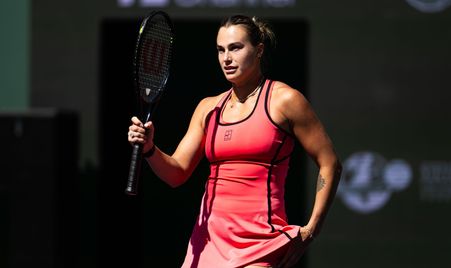
That's also the dynamic Sabalenka expects when she takes on Osaka on Sunday.
"I think every match was very tough one," she said of their meetings this year. "In every match there was, like, few key moments of each set where I think I was able to trust my game and to step in and to put pressure on her. I feel like every time she play me, she's more focused. She's aware of my power and aggression and everything. I feel like every time she's handling herself really good and handling the pressure good.
"I'm ready to go out there and to fight."