







How is the Paris heat affecting tennis at Roland Garros? Here's what the players said
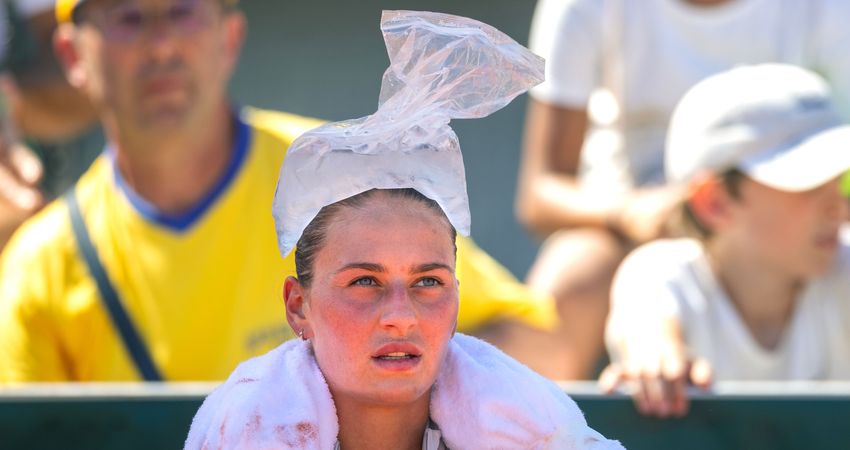
PARIS -- In an opening week filled with upsets, routine wins and a handful of instant classics, one storyline has touched nearly every match at Roland Garros: the heat.
"I can't remember a Roland Garros where it was this hot for this many days, but there has definitely been weekends here or there, and I have just always really liked playing here when it's nice and hot," Keys said to press after her second-round win Thursday.
Since last Saturday, daily high temperatures in Paris have topped 32 degrees Celsius (90 degrees Fahrenheit), according to France's national weather service. The cause has been dubbed a "heat dome," where a warm air "bubble" from northern Africa complemented with high pressure has been moving toward the country. Last Monday, May 25, was also the hottest day in May on record in France (36 degrees Celsius, 97 Fahrenheit).
Next week, however, the conditions are forecasted to flip. As rain is expected to hit the Paris area and conditions cool significantly, temperatures are forecast to range from 12 to 21 degrees Celsius (55 to 75 Fahrenheit), with wind potentially adding another challenge.
How does the heat affect the players on court? Here's what you need to know:
How the heat affects on-court play?
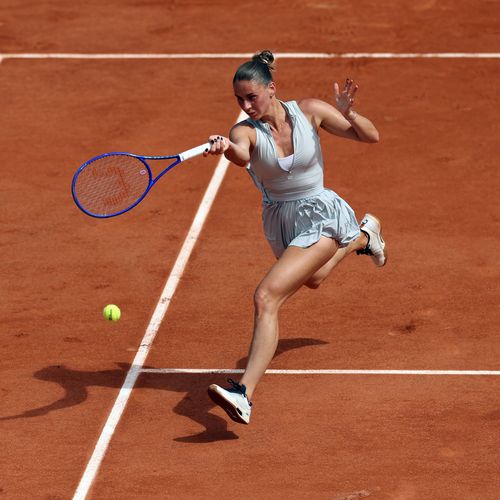
When the sun hovers over the red-clay courts, the clay hardens and creates a much faster surface. Generally, faster conditions favor players who are strong servers, power hitters and those who utilize an aggressive play style with their shot selection and top spin.
In warmer conditions, the air is thinner and the ball tends to travel more quickly with a higher bounce because the pressure and gas inside of the ball expands. When cooler, the pressure decreases and creates a heavier ball. Those cooler conditions tend to slow the courts and make points more physical, placing a greater premium on patience, movement and point construction.
Heat can also affect a player's racquet. Higher temperatures tend to reduce string tension, creating a livelier string bed that can generate additional power -- one reason big hitters often prefer hotter conditions. By contrast, higher string tension provides greater control and precision, which can benefit players who rely more on placement, spin and shot-making variety.
During her first-round match against Taylor Townsend, World No. 4 Coco Gauff even stored her racquets in the beverage cooler next to her bench in an effort to maintain string tension. But by the time she pulled them out, she laughed, the conditions were so warm that the racquets had heated up almost immediately.
"Last match, I did it because my coach told me, because when I was practicing, he felt like the tension was dropping because of the heat," Gauff said Thursday. "He was like, 'Can you put it in the fridge?'
"So it wouldn't be his fault if my racquets were messed up. It was strictly for tension. Today, it was hotter, but by the time I played, the court was completely shaded, so I didn't feel like I needed to do it today."
Sliding into R3
— wta (@WTA) May 28, 2026
Madison Keys moves through to the next round by defeating Ruzic in straight sets 6-4, 6-4!#RolandGarros pic.twitter.com/oEFu41EOsu
What the players are saying?
Keys (May 28): "I love it so much. It plays super bouncy and fast. I grew in Florida, so the heat doesn't really bother me, especially here the last couple of days. It's been very nice just because it hasn't also been humid, and I think on clay, it always feels a little bit better, just because you don't have the radiant heat from the court. I will take a hot Paris red clay day over a cold, rainy one every day.
"I think the clay changes pretty drastically, depending on the conditions. [If[ it gets heavier and colder, you know you're probably going to have make better shot selection, points are going to last a little bit longer. You're maybe just not going to get as many freebies."
Iga Swiatek (May 27): "Overall usually the weather is quite different here, but it doesn't matter. It's going to change in the second part of the tournament. I guess this tournament is really about whoever will cope with both of these conditions will win."
Marta Kostyuk (May 29): "I love that there is a high bounce so I can do different things that I get more advantage from this height. Other than that, I mean, it was really hot. I think it's going to be much slower on Sunday than all of these matches that I have played. It's going to be a cool match."
Elena Rybakina (May 27): "When it's so hot, the ball is flying. It's very difficult to control. Especially me being always aggressive, trying to play fast and step in, if you don't give enough spin or if your hands are not as fast, the ball is flying everywhere. In such condition you really need to be super patient, try to spin the ball as much as you can, and definitely come to the net."
Elina Svitolina (May 27): "You cannot control the weather. As soon as you wake up, me personally, I check the weather every time. A couple of days ahead as well to see how I need to adjust my tension or my preparation. When it's so hot, you just are trying to survive, not only playing against the opponent, but also playing against the conditions. It's like this unfortunately in tennis, but I think it's the sweetness of it."
Belinda Bencic (May 27): "For me, it's perfect. I love this right now [smiling]. I also like the heat. I don't like to play when it's cold and wet and windy. I really like the conditions. In my hour, hour-and-a-half match, I feel for me it's very good when it's this hot. It's good for my tennis."
Aryna Sabalenka (May 26): "When I first got here, it was like 14 degrees, freezing. Now it's, boiling hot and balls are flying, everything is much faster. Physically I feel strong, so I feel like it can benefit me, and I just try to stay strong and ignore the weather [smiling]."
Maria Sakkari (May 28): "I'm loving it. I wish it could stay like that for the whole two weeks. I want it hotter if it's possible. I'm pretty sure not everyone likes this. I grew up playing in these conditions, and for us, this is nothing, 30 or 31 degrees [Celsius]. It's easy, we grew up playing in 40, 42. Not bothered at all."