





Chwalinska breaks new ground as first qualifier to reach Roland Garros final
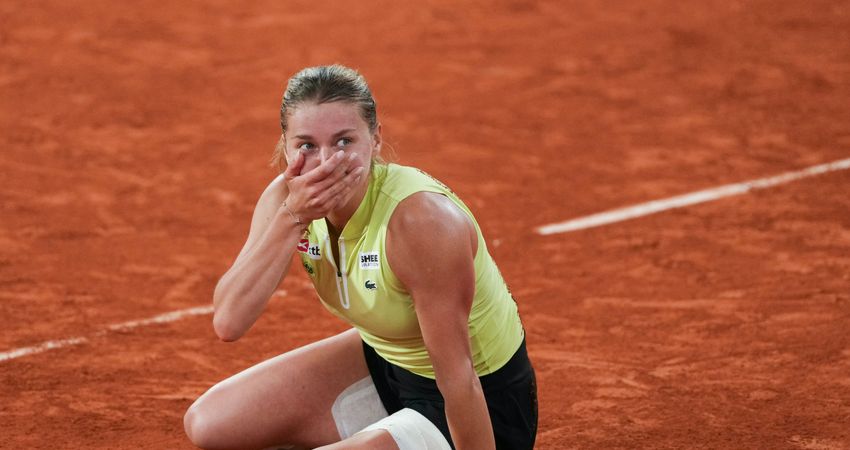
Maja Chwalinska entered Roland Garros this year simply hoping to play her way out of qualifying. Instead, she made history -- and she’s not done yet.
Roland Garros: Scores | Order of play | Draws
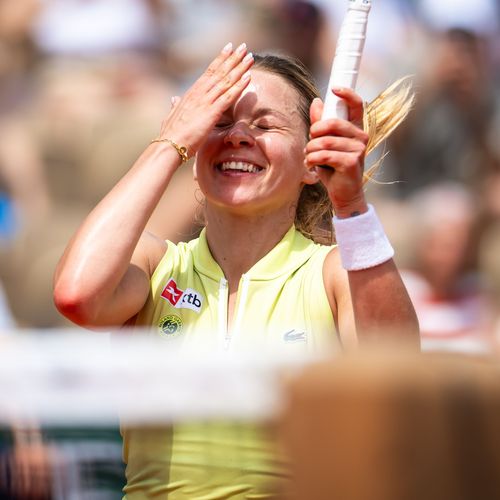
After defeating No. 25 seed Diana Shnaider 7-6 (4), 6-4 in 2 hours and 10 minutes on Thursday, the 24-year-old became the first qualifier in tournament history to reach the final. She is also just the third woman to make the Roland Garros final in her main-draw debut, joining Evonne Goolagong (1971) and Chris Evert (1973).
"It's like a dream, honestly," Chwalinska said in her on-court interview. "I don't know what's going on. I don't know what to say. I'm just very happy.
"It's so challenging to play against the best players in the world, day by day, but it's a Grand Slam so you just have to give your all and more. I'm not complaining at all."
Chwalinska arrived in Paris with a career-best ranking of World No. 113 and is now knocking on the door of a Top 20 debut. More importantly, she’ll face fellow first-time finalist Mirra Andreeva on Saturday for a chance to win her first -- and a most improbable -- Grand Slam title.
It will be the first meeting between Chwalinska and Andreeva at the WTA Tour Driven by Mercedes-Benz level, a matchup featuring two of the tour’s more versatile players. It will also mark Chwalinska's first career meeting with a Top 10 opponent.
"I played (nine) matches here already, so there are no secrets," Chwalinska said. "But I watched Mirra a bit. They were playing before us, so I watched her game and it was incredible. It's just another great experience for me. I will for sure give my all. It's a Grand Slam final."
The matchup will be a stark contrast to the power-versus-precision battle Chwalinska navigated against Shnaider, a grueling and physically demanding two-set duel that required every ounce of her variety and craft.
'Maja magic' gives Chwalinska the early advantage
The tone for the match was set in the opening game, with Chwalinska showcasing her mix of shots while Shnaider unloaded on her forehand with the same force she displayed in her upset of World No. 1 Aryna Sabalenka in the quarterfinals. The result was extended games, extended rallies and a level of physicality that delighted the Court Philippe-Chatrier surely far more than the players themselves.
Early on, that rhythm favored Chwalinska. She struck first with a break at love for a 3-1 lead. But after a back-and-forth exchange of backhands in the next game, her trademark slice drifted wide, handing Shnaider the break back for 3-2. Chwalinska responded by winning the longest rally of the match, a pattern that would haunt Shanider later, but Shnaider followed with another rocket forehand to level at 3-all.
After 68 minutes -- nearly as long as the entire semifinal between Andreeva and Marta Kostyuk -- the set moved into a tiebreak. Shnaider grabbed the mini-break on the opening point and built a 4-2 advantage, but Chwalinska, showing the grit of a player who needed eight wins just to reach this stage, reeled off five straight points. The penultimate one came on a perfectly placed lob winner, and Shnaider's ensuing backhanded landed wide to hand Chwalinska the opening set.
In the end, the set lasted 1 hour and 17 minutes, one minute longer than the entire Andreeva-Kostyuk match.
Late break cements Chwalinska's place in the history books
The physical toll of the match caught up to both players in the second set. Chwalinska was the first to show signs of trouble, grabbing at her heavily taped left leg and calling for the physio. A few games later, after holding serve to edge ahead 4-3, Shnaider took a medical timeout to receive treatment around her lower back.
As it turned out, that hold was the last game Shanider would win. After the players exchanged breaks in the opening two games and traded holds through 4-4, Chwalinska backed up her serve by going to the well once more with a drop shot that secured the decisive break for 5-4. Serving for the match, she emptied the bag of tricks with a backhand winner down the line for 30-15 and, finally, a forehand that planted itself on the line to send the Pole into her first Grand Slam final.
Thus, the only question that remains is whether the slipper will fit the way it did for Emma Raducanu, who won the 2021 US Open after becoming the first qualifier in the Open Era to reach a Grand Slam singles final.
The 2nd qualifier in open era to reach a Grand Slam final, the first one at Roland-Garros 📚
— Roland-Garros (@rolandgarros) June 4, 2026
A historical achievement for Maja Chwalinska to highlight our stat of the day by @Infosys 📊#RolandGarros #RolandGarroswithInfosys #ExperiencetheNext pic.twitter.com/OX215vyKbE
The parallels are striking. Like Raducanu, this is only Chwalinska's second appearance in Grand Slam main draw. This also marks her first tour-level final, just as it was for Raducanu in New York five years ago. In fact, Chwalinska is only the third player to reach her first WTA-level final at a Slam, joining Raducanu and Venus Williams, who made her breakthrough at the 1997 US Open.
What awaits Chwalinska on Saturday is anyone's guess, but if she brings the level she showed against Shnaider (32 winners to 17 unforced errors), she'll have a chance to write a remarkable ending to her already historic and career-altering tale.
She is fully focused on the moment ahead.
"I didn't have many experiences, many opportunities before to play against such great and high-ranked players," Chwalinska said in her post-match press conference. "So it's actually the first time that I have this opportunity. I'm happy that I'm taking it (smiling). Now I know that my ranking will allow me to play more in the (bigger) tournaments. Yeah, I guess we'll see how I will continue. For now, I'm just trying to focus on one more match."
One win short of the final, Shnaider gives 'kudos' to Chwalinska
On Wednesday, Shnaider ousted the World No. 1 for the biggest win of her career. The very next day, she was on the receiving end of the best win of Chwalinska's career. That is the harsh reality of tennis.
Phenomenal level of tennis between Maja Chwalinska and Diana Shnaider today, check out the highlights ↘️ #RolandGarros pic.twitter.com/LNQRUhj3J4
— Roland-Garros (@rolandgarros) June 4, 2026
It will undoubtedly be a tough pill to swallow for the 22-year-old, who entered as the favorite given her recent form and past success, even with this being her first Grand Slam semifinal as well. In front of her was the chance not only to reach her first Major final, but to do so against Andreeva, her friend and doubles partner.
But when the clay dust settled, all she could do was give credit where it was due.
"All the kudos to Maja," Shnaider said in her post-match press conference. "She played amazing. I feel like both of us played some really good tennis. It was a very hard battle. I tried my best, and I tried different things. Yeah, I left it all out there. I'm proud of the way I played, the way I fought.
"She played unreal, and she definitely deserved this win today and to be in the final."