






'Chris & Martina: The Final Set' is honest, raw and remarkably powerful
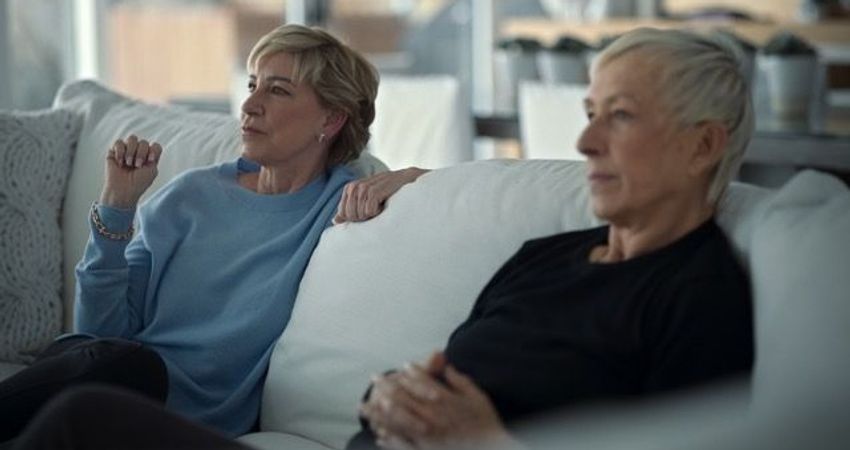
Chris Evert and Martina Navratilova's rivalry has been closely documented for decades. But for the first time, viewers are getting a rare look at the evolution of their relationship, dating back to the early 70s, and how their bond became unbreakable as they navigated respective cancer battles.
In "Chris & Martina: The Final Set," which premiered on Netflix on June 26, two-time Emmy Award-winning filmmaker Rebecca Gitlitz pulls back the curtain on their early years, which were cordial and friendly, and then the iciness that followed as their rivalry reached a fever pitch.
Evert had the upper hand initially, winning nine of their first 10 matches and 20 of their first 25. But as Navratilova shifted to a win-at-all-costs attitude and became fanatical about fitness, she caught up to Evert and eventually surpassed her in their head-to-head, winning 43 of their almost unfathomable 80 matches over the course of 15 years.
Evert and Navratilova dominated the WTA Tour Driven by Mercedes-Benz, and elevated women's tennis -- and women's sports -- to new heights, all while doing it with contrasting styles and personalities.
Evert was the All-American Floridian, instantly adored and beloved, quickly rising to movie-star fame. Navratilova, who defected from communist Czechoslovakia, was more often scrutinized and didn't receive that same level of affection and support (though she eventually would, many years later).
In addition to insight from Evert and Navratilova in the present, their rivalry is told through never-before-seen footage and rare interviews from their playing days, and complemented by analysis from tennis luminaries that lived it alongside them, including soon-to-be Hall of Fame inductee Mary Carillo, former World No. 3 Pam Shriver and John McEnroe.
Some of the most eye-opening scenes in the film occur when Evert and Navratilova speak candidly to each other, coming to new realizations about their personal challenges and thought processes despite having known each other intimately for more than five decades.
During one conversation in the stands at Indian Wells, Evert is stunned to find out that Navratilova's only sponsor was her racquet brand. To achieve that level of success, and to reach (and stay at) the top, they had no choice but to live in their own bubble.
Now far removed from that bubble, they view much of the past through a different lens.
"That was a very hard and beautiful scene to film," Gitlitz said, "because I think Chrissie is at a stage where she's willing to listen. I think that part of being No. 1 is you live in your own bubble, without letting anything in. And so [they] may be sort of understanding things for the first time."
They also rewatch some of their classic matches together for the first time, with a mix of laughter and fondness and heartbreak. Their retrospective commentary sheds light on what they were feeling and experiencing at critical points of matches, breaking down the intentionality behind their body language, words and tactics. It's a fascinating insight into the human experience of being so young and so vulnerable, with all the pressure that comes with trying to be the best in front of the whole world.
"Chris takes it from the emotional point of view," Navratilova said of the rewatches. "I’m thinking I should have hit to her forehand more, I should have hit more drop shots. I totally see it from a strategy or technique viewpoint. But it was funny because neither one of us ever watched those.
"And then you remember, 'Oh, that’s what happened on that point, or that was the score, or I forgot I had that break point.' It was just funny from a tennis viewpoint, as well as the emotional, how we reacted in between points. It was a trip down memory lane."
One of the matches they watched together was the legendary 1978 Wimbledon final.
Coming into that final, Evert had dominated their rivalry. She won the first set comfortably, and appeared to be well on her way to a seventh Grand Slam title, before something happened that appeared minor on the surface, but very well may have been the turning point of their rivalry, and of Navratilova's career.
In the eighth game of the second set, with Navratilova leading 4-3, she was hit square in the head by an Evert forehand at the net. Both players shared a laugh afterwards, with Evert giving Navratilova a friendly pat on the head.
"It's a little patronizing," former Washington Post writer Sally Jenkins says in the film. "It's a sweet gesture, but it's also very unthreatened. And something about that shot hitting her in the head seems to shake something loose in Martina."
"It sure did," Evert adds, reliving the moment alongside her former rival nearly 50 years later. "You were a different player after that."
Navratilova would win the match in three sets for her first major title, and would go on to win 17 more over the next 12 years. (Both Hall of Famers finished with 18 Grand Slams.)
Their competitiveness on the court is expertly juxtaposed with their present-day cancer battles. We see them receiving treatment at Memorial Sloan Kettering in New York and the Cleveland Clinic in Florida, and watch their difficult conversations with doctors about next steps and prognoses. They call each other with updates and bring soup to each other for comfort, as any old friends might do, and in those moments it's easy to forget that they were two of the greatest tennis players of all time who changed the game forever.
As dark as some of those moments are, it's equally uplifting to see how much they truly care and love each other, and to see their genuine and heartfelt reactions when the other shares positive news.
Viewers are also reminded that these two powerhouses handled their cancer like they did their careers, with focus and determination and a belief that they'll come out on the other side, no matter what is required.
They let Gitlitz, and the viewers, fully into their world, even in their most challenging and most exposed moments, and that's what makes this film so powerful and unique.
"They are relentless people," Gitlitz said. "They are all-in. If Chrissie says she's going to do something, she's going to do it. They did cancer the way they did their tennis. They are just really legendary human beings. They are everything you think they're going to be, and more. They are ruthless, and that's what it takes to be legendary. And I mean ruthless in the best possible way.
"I was so unbelievably inspired. We would go back to the edit, and I'd be like, 'We are gonna work for 24 hours. I don't care what it takes.' They deserve the film that they put in the work for. And that is how we worked, because they deserved it."