









The first-timers who won the WTA Finals: Could Andreeva or Noskova be next?
Last October, Mirra Andreeva went into the final week of the WTA Finals race in eighth place, holding the last available spot but with little room to breathe. Elena Rybakina was close behind, and Jasmine Paolini was still in the mix, leaving three players to contend for the final two places in Riyadh.
That picture held into Tokyo. When the week was over, Rybakina and Paolini had captured the two berths, and Andreeva was left on the outside looking in.
That was then. This season has offered Andreeva a far less precarious view of the Race.
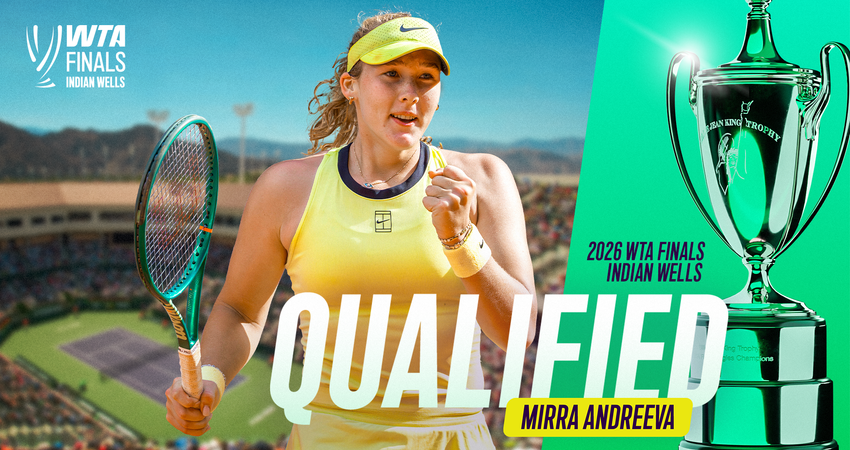
On Friday, Andreeva secured her place at the season-ending WTA Finals well before the late-season squeeze. The French Open champion was joined by Linda Noskova, another first-time Grand Slam winner this year after her Wimbledon title.

They will make their first WTA Finals appearances in Indian Wells alongside Rybakina and Aryna Sabalenka, the world’s top two players.
"This year I'm just happy that I have better odds," Andreeva said. "I'm playing better. I keep earning more and more points. That's looking good."
Said Noskova: "I feel at the end of the year, it's always really important to find motivation, to find the strength -- either mental or physical. Once you can really mentally focus on just a few tournaments, give it all, hopefully I can get some great results."
A first trip to the WTA Finals has rarely come with an easy path to the title. Since the inaugural edition in 1972, only seven women have won the event in their first singles appearance. Andreeva and Noskova will arrive in Indian Wells looking to join them.
Here’s a look at the those players who won the WTA Finals in their first appearance:
2019 Ashleigh Barty
City: Shenzhen, China
Opponent in final: Def. Elina Svitolina, 6-4, 6-3
What it meant: Barty arrived in Shenzhen having already won Roland Garros, risen to No. 1 and become the first Australian to finish a season atop the rankings since Evonne Goolagong Cawley in 1976. At the WTA Finals, she had one last chance to measure that season against the seven players who had spent the year trying to catch her.
After a round-robin loss to Kiki Bertens, Barty beat Karolina Pliskova in the semifinals and defending champion Elina Svitolina in the final. The straight-set win over Svitolina was her first in six meetings and ensured she would finish 2019 as year-end No. 1.
2016 Dominika Cibulkova
City: Singapore
Opponent in final: Def. Angelique Kerber, 6-3, 6-4
What it meant: Cibulkova’s run remains one of the more unlikely title stories in WTA Finals history. She needed to win Linz to qualify for Singapore, then lost her first two round-robin matches to Angelique Kerber and Madison Keys. A win over Simona Halep kept her alive, and she made the most of the opening.
After defeating Svetlana Kuznetsova in the semifinals, Cibulkova turned the result of her first match around against Kerber, beating the World No. 1 in straight sets for the biggest title of her career. Cibulkova became only the second player in the current round-robin format to win the WTA Finals after advancing from the group stage with a 1-2 record.
2011 Petra Kvitova
City: Istanbul, Türkiye
Opponent in final: Def. Victoria Azarenka, 7-5, 4-6, 6-3
What it meant: At the start of 2011, Kvitova was outside the Top 30. By the time she reached Istanbul, the 21-year-old had won Wimbledon for her first Grand Slam title and collected six trophies, tied with world No. 1 Caroline Wozniacki for the most on tour.
Her three-set final against Victoria Azarenka was a fitting finish. Kvitova saw a 5-0 first-set lead disappear before closing it out, then recovered from losing the second set to capture the title and move to No. 2 in the rankings.
2004 Maria Sharapova
City: Los Angeles
Opponent in final: Def. Serena Williams, 4-6, 6-2, 6-4
What it meant: Sharapova’s 2004 season had already made her the sport’s newest star. At 17, she upset two-time defending champion Serena Williams to win Wimbledon, then carried a late-season run through Seoul and Tokyo into Los Angeles, where she was making her WTA Finals debut.
She and Williams met again in the final, and Sharapova rallied from a set down to win in three sets. It was the second straight notable final in which she had beaten Williams, and it completed a year in which the teenager went from intriguing prospect to one of the game’s central figures.
2001 Serena Williams
City: Munich, Germany
Opponent in final: Def. Lindsay Davenport, walkover
What it meant: It was the showdown that never happened. Williams was 20 and seeded seventh when she arrived in Munich for her WTA Championships debut, two months after reaching the US Open final (where she lost to her sister Venus). In Munich, Williams dropped only three games against Sandrine Testud in the semifinals to reach the championship.
Davenport secured the year-end No. 1 ranking by beating Kim Clijsters in the other semifinal, but a right knee injury forced her to withdraw before facing Williams. It was the first of five WTA Finals titles Williams would win.
1974 Evonne Goolagong
City: Los Angeles
What is meant: Goolagong’s victory in Los Angeles came at the end of a season in which she had already won the Australian Open, the first of her four titles there. In the final, she beat Chris Evert, who had entered the event as the top seed and was in the midst of a season that included a 55-match winning streak.
It was Goolagong’s first WTA Finals title, and she would beat Evert again in the 1976 final to win the event for a second time. Across a career that made her one of the defining players of the 1970s, Goolagong won 86 singles titles and 46 in doubles.
1972 Chris Evert
City: Boca Raton, Florida
Opponent in final: Def. Kerry Melville, 7-5, 6-4
What it meant:
What it meant:
What it meant: Evert was the first player to win the WTA Finals in her debut, helped slightly by the fact that this was the first such event. It still counts, and the 17-year-old made it count, winning all five matches without dropping a set.
The third seed came back from 3-0 down and saved set points at 5-2 in the final to beat Kerry Melville 7-5, 6-4 before a sellout crowd in Boca Raton. One family footnote: Evert’s sister Jeanne also played in the inaugural event, losing her first-round match to Margaret Court.
For Chris Evert, it was an early marker in a career that would include three WTA Finals titles and 157 singles trophies.