




From 6-3, 4-1 down, Shnaider stuns Sabalenka to make first Slam semifinal
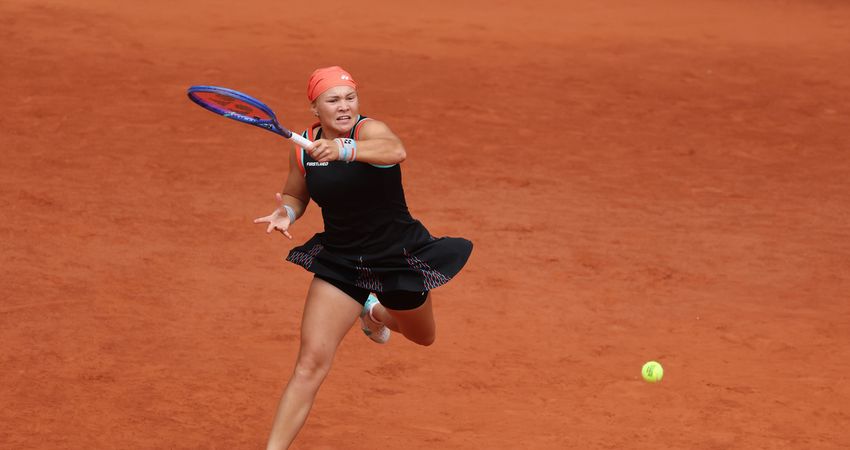
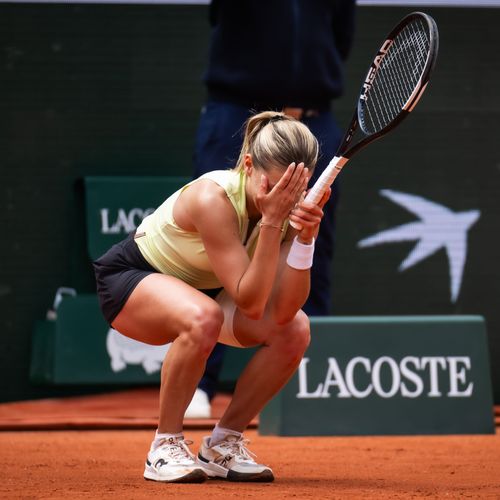
No. 25 seed Diana Shnaider pulled off a sensational upset in the Roland Garros quarterfinals on Wednesday, coming from a set and a double break down to stun Aryna Sabalenka 3-6, 7-5, 6-0 in 2 hours and 12 minutes, snapping the No. 1 seed's streak of six consecutive major semifinals.
Shnaider, 22, was competing in her first Grand Slam quarterfinal and facing a reigning World No. 1 for the first time. As gusts of wind swirled around Court Philippe-Chatrier, she mastered the conditions and met the moment in superb fashion to make the major semifinal debut.
From 6-3, 4-1 down Shnaider produced winner after winner with her left-handed forehand to win 12 of the next 13 games, and the last 10 in a row from 5-3. By contrast, Sabalenka's control over her game abandoned her as she racked up 57 unforced errors -- 17 of which came in the decider alone, the first time she had dropped a 6-0 set since the third set of her 2024 Dubai second round against Donna Vekic. Shnaider, meanwhile, scored her second 6-0 third set in a row, having defeated Madison Keys 6-3, 3-6, 6-0 in the fourth round.
Shnaider, a five-time titlist on the WTA Tour Driven by Mercedes-Benz, claimed her second Top 10 win in 16 encounters, and first since defeating Coco Gauff in the 2024 Toronto third round. She becomes the second-youngest active player with a major semifinal on her resume -- the youngest, 19-year-old Mirra Andreeva, has also reached the final four in Paris.
This tournament marks the first time that a Grand Slam semifinal lineup has been entirely comprised of players born in the 21st century. Andreeva (born 2007) is the youngest, followed by Shnaider (born 2004), Marta Kostyuk (born 2002) and Maja Chwalinska (born 2001). It's also the first time in 15 years that all four semifinalists at a major are aged under 25 -- at Wimbledon 2011, the last four were 21-year-old champion Petra Kvitova, 24-year-old runner-up Maria Sharapova and 21-year-old semifinalists Sabine Lisicki and Victoria Azarenka. A brand new Grand Slam champion is also guaranteed -- the last time a major semifinal lineup contained no previous champions was the 2021 US Open (Emma Raducanu, Leylah Fernandez, Maria Sakkari and Sabalenka).

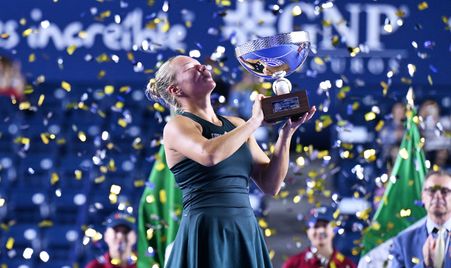
"Tough conditions with the wind, first time playing Aryna, super nervous," Shnaider said in her on-court interview. "Quarterfinals for the first time, definitely a lot of nerves. I feel like first there was trying to adjust to her game and then to the conditions, to the wind. Trying to figure out how to play. I was just trying to focus point by point, not thinking about the score. I was like, it's OK. It's tough conditions, she's the World No. 1. I will just try to do my best to the end and we'll see how it goes. Try to fight for every point and try to run for every ball and make it extra into the court."
Shnaider will face another first-time Grand Slam semifinalist, Polish qualifier Chwalinska, as both players bid to reach their first major final. It will be the first Roland Garros semifinal between left-handers in the Open Era, and third at any Slam following Monica Seles' defeat of Martina Navratilova at Wimbledon 1992 and Kvitova's win over Lucie Safarova at Wimbledon 2014. Shnaider and Chwalinska have faced each other once before, with Shnaider winning 6-4, 6-4 in the 2022 Istanbul ITF W60 semifinals on clay (going on to defeat Nikola Bartunkova in the final).
"Of course I remember playing her," Shnaider said in her press conference.
"I even remember where was it. It was 60K in Istanbul. It was semifinal. She's a very tricky player, so I'm not surprised that she's good. Sometimes, it just takes time. But she's very tricky with the dropshots and slices. Obviously she's a lefty. So it's gonna be a big switch for me for tomorrow's match. Happy for her. I'm expecting a huge fight tomorrow. I feel like both of us is gonna be leaving it all out tomorrow with huge opportunity in front of us. So I feel like it's gonna be a great match."
4 - Diana Shnaider is the fourth player since the WTA Rankings were published in 1975 to claim a GS third-set 6-0 against the World No. 1 after Steffi Graf (RG 1995), Serena Williams (AO 2005) and Maria Sharapova (US Open 2006). Thunder.#RolandGarros | @rolandgarros @WTA
— OptaAce (@OptaAce) June 3, 2026
The result was Sabalenka's third loss from a set up against an opponent ranked outside the Top 10 in this year's clay-court swing. She fell 2-6, 6-2, 7-6(6) to Hailey Baptiste in the Madrid quarterfinals (from six match points up) and 2-6, 6-3, 7-5 to Sorana Cirstea in the Rome third round. She has reached 14 Grand Slam semifinals -- the most of any player born after 1987, and the joint-16th most in the Open Era -- but has converted just four of those into titles.
Shnaider came into Roland Garros with just a 13-11 season record, and only one semifinal run under her belt (in Adelaide in January). But performances such as her triple-tiebreak loss to Keys in Brisbane and a 3-6, 6-3, 6-2 defeat at the hands of Jessica Pegula in Charleston were indications of the level she was able to produce -- and in Paris, she's been able to turn superb shot-making into big-stage wins.
Set one: Sabalenka imperious ... but the cracks start to show
Sabalenka roared out of the blocks in imperious form, perfectly befitting a World No. 1. The first two points alone showed off both her power and her touch -- a bludgeoning backhand winner, followed by the softest of angles on a forehand winner. Drop shots, angled passing shots and a neat backhand volley followed as she broke for 5-1.
But as the wind began to pick up, Sabalenka's game began to rattle. She missed two set points serving at 5-1, the first on a double fault and the second on an errant forehand. Though she got over the line two games later, this was in part down to Shnaider over-pressing in her bid to take advantage.
Set two: With her back to the wall, Shnaider begins remarkable comeback
The second set started out in identical fashion to the first. Shrugging off her end-of-set wobble, Sabalenka found her control again to break Shnaider for 1-0 with a short backhand angle, and again for 4-1 with a hefty forehand crosscourt. There was little sign of either Sabalenka's level falling, or even of Shnaider finding the best of her first-set form.
With Sabalenka serving at 30-15, Shnaider got the slice of luck she needed: a net cord that enabled her to find a backhand winner. Instead of double game point to the top seed, it was 30-30. One drop shot into the tramlines and one double fault later from Sabalenka, and Shnaider had a foothold in the set.
Sabalenka seemed to have escaped danger when she fended off four break points to hold for 5-3. But, serving for the match at 5-4, 30-15, she tapped a simple volley that would have given her double match point wide. Handed another lifeline, Shnaider grabbed it and ran -- and didn't let up.
Shnaider slammed a forehand winner down the line to break back for 5-5, and another en route to holding for 6-5. She conjured a brilliant pass followed by a pinpoint reflex lob en route to breaking for the set, converting her first set point by rifling a return at Sabalenka's feet.
"At 5-3, I was on the opposite side from the coaches' boxes, I was playing against the wind," Shnaider recalled in her press conference. "And then with Aryna putting pressure I was like, I gotta think of something different, because I was trying to go for more variety, trying to put more spin, the slices. So it didn't work.
"You know, 5-3, whatever, I have to change something up now. I feel like I just had the relief where I was like, I gotta go for my shots, I have to be more aggressive, I got to step in, because she's pushing me too much back and just winning those short rallies. So I've got to be more aggressive. I gotta just do something different. And then I was starting to step in more on her second serve, putting more pressure, being more aggressive.
"Then she got, like, just some couple unforced errors here and there. So that momentum a little bit shifting towards my side."
Set three: Shnaider elevates, Sabalenka deflates
There was no slowing Shnaider's momentum in the third set. Indeed, there was just one close game -- the second, which Sabalenka had led 40-15. Both players produced superb shot-making in it, with a lobbed Shnaider pickup off a Sabalenka volley one of the finest examples -- but Sabalenka also repeatedly found the net with her backhand on game point. After six deuces, Shnaider held her nerve to put away another forehand winner on her fourth break point.
The remainder of the set was completely one-sided: Shnaider did little except strike winners -- 25 in total, of which 10 came in the decider -- while Sabalenka was increasingly unable to keep the ball in court. Down 5-0, the reigning US Open champion opened her service game with a forehand shank that drew gasps and encapsulated her woes. A few points later, yet another backhand found the net as Shnaider ran away with 17 of the final 22 points of the match.

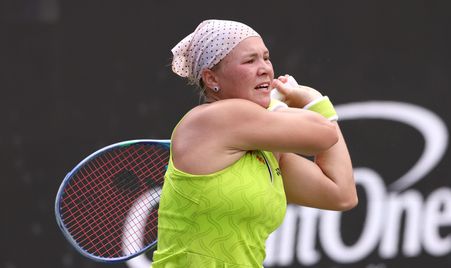
"In the third set I finally found my rhythm and how to play," Shnaider said. "When to be a little bit more defensive, when to attack. The third set was the one I should be aiming for from the beginning. But definitely super happy I managed to finish on a good note, and not [just] to start on a good note!"
Sabalenka was left to rue the reverse dynamic.
"I feel like I had very decent opportunities in the second set," she said in her press conference. "I screw up, and then she stepped in and she played great. I feel like mentally I couldn't really recover after second set. That was the biggest mistake from me.
"I don't know when was the last time that happened to me that I lost 10 games in a row. I don't know. I guess mentally I got into very deep, deep, dark hole over there, and I just couldn't get back mentally on track."


"It's the same conditions for both of us"
Neither Sabalenka nor Shnaider enjoyed the windy conditions, a far cry from the heatwave that baked Paris in the first week of the tournament.
"Even though I was winning, it was very dirty tennis," Sabalenka commented. Shnaider echoed her language: "A lot of dirty shots, very unpredictable, a lot of wind, a lot of sand," she said.
Shnaider admitted that she spent the first set being annoyed by the weather. But a turnaround in her mindset spearheaded a turnaround in the score -- as well as remembering her opponent's history in the wind, specifically Sabalenka's loss in the 2025 final to Coco Gauff.
"I just tried to keep reminding myself that it's same conditions for both of us," Shnaider said. "I gotta just admit that it's tough, and I just need to figure out what I have to do. Like, where the wind is going, what should I do from this side, what I should do from the opposite side?
"Of course I knew the final last year, I watched it. I knew that it was also super windy. So of course I had that thought in back of my mind that she was struggling with Coco last year. I was, like, 'Yeah, I gotta use this opportunity, I need to just adjust and do my best.'"