


The Grand Slam season has come full circle.
More than seven months after Aryna Sabalenka and Elena Rybakina met in the final of the year's first major, on hard courts, they're set to meet again in the final of the year's last major, again on hard courts.
The major difference between then and now is that Rybakina, then ranked fifth in the PIF WTA Rankings, will be the new No. 1 next week, ending Sabalenka's 99-week streak at the top.
Will the results of their Australian Open final rematch, a come-from-behind win for Rybakina in Melbourne, flip as well?
We'll find out on Saturday when Rybakina and Sabalenka, the top two seeds in New York, meet in the US Open final (4 p.m. ET).
Sabalenka, looking for a three-peat in New York, booked her spot in her fourth consecutive US Open final with a dominant 7-5, 6-2 win over Jessica Pegula on Thursday night.
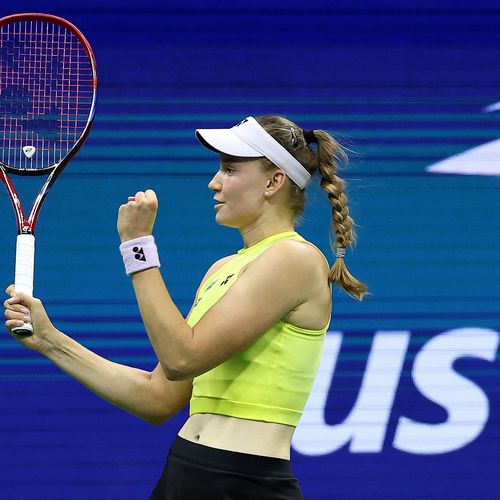
In the second semifinal, Rybakina came from a set down to beat home favorite Coco Gauff 3-6, 6-4, 6-4 to reach her first career US Open final.
Ahead of the final on Saturday, we make the case for both players.

The Case for Sabalenka
Sabalenka just seems to find another gear in New York.
The two-time defending champion arrived in Flushing Meadows last year without a Grand Slam title, feeling an immense pressure to win the US Open after disappointing near-misses (for her) in the previous three majors. She rose to the challenge, dropping just one set en route to the title.
She's followed a similar script this year. Coming off subpar results at Slams (again, for her), and with many questioning her form heading into the US Open, she's played her best tennis since March. She's dropped just one set through her first six matches, and looked especially overpowering against Pegula. She admittedly feels some desperation right now, and that mindset appears to have her locked in.
"It kind of like feels for me, talking about Grand Slams, a last push of the season," Sabalenka told reporters on Thursday. "I wanted it badly, to go to the final, and of course I want to go all the way. The mentality was just, I'm ready. I'm ready for whatever it's going to take to get the win."
From Pegula's view across the net, it's perhaps the best Sabalenka has looked all year.
"I think that's probably the best match she's played this year," the third-seeded American said. "I mean, I thought her level was insanely high. ...She played insane. She played a super high level. Honestly, I don't really know if there was much I could do today."
Though five of her wins in the lead-up to the final have been routine, she's had the benefit of being tested. Sabalenka was pushed to a third-set super tiebreaker against Linda Noskova in the quarterfinals, ultimately gutting it out 10-7 to get a further confidence boost.
Sabalenka's backhand has been elite throughout this tournament, and her aggressiveness from both wings has helped her dictate points early. No player has hit more winners (170) than Sabalenka in New York, and she's also been highly effective on the return, converting more break points (25) than anyone in the field.
She enters this final with a 20-match winning streak at the US Open dating back to 2024, and since 2022 she's gone 31-2. This is also her eighth consecutive Grand Slam final on hard courts.
And though the Australian Open final loss to Rybakina still stings, Sabalenka owns a career 10-7 record against her in WTA Tour Driven by Mercedes-Benz play. After the loss in Melbourne, the World No. 1 rebounded with back-to-back wins over Rybakina in the Indian Wells final (a classic that ended in a third-set tiebreaker) and the Miami semifinals.
The Case for Rybakina
Rybakina just has that clutch gene.
We saw it last year, when she won six straight matches to qualify for the WTA Finals, then swept the year-end tournament with five more wins. She carried that momentum into this season, with the Australian Open title, and after a few months of playing below her standard, she's shown that clutch gene again.
After suffering a left ankle injury in Cincinnati three weeks ago, the soon-to-be World No. 1 seemed like something of a question mark heading into this tournament. It was painful for her to walk after that injury, she said, and the recovery process was slow. But there was a lot to play for at this particular tournament. The stakes are always high at majors, but this one came with the added pressure of the World No. 1 ranking on the line, a high watermark she'd never achieved.
She needed a run to the semifinals in New York to get it -- another feat she'd never accomplished in eight prior appearances here.
But she promptly put all injury concerns, and previous US Open woes, aside with a spirited run to the semifinals. That included a win over two-time champion Naomi Osaka, as well as a pair of come-from-behind three-set wins over Qinwen Zheng and Gauff.
Rybakina had lost more than a few painful three-setters at Slams in recent years, but showed tremendous resilience and poise in these two, especially the semifinal against Gauff. With the crowd firmly and fervently behind the American, Rybakina stood her ground, muted the noise and hit big shots at the most critical moments.
"She does a great job of just being there every point and putting a lot of pressure on you on [the] service game and return game," Gauff said after the match. "I think she was able to hold the line a bit better than I could tonight."
Much like Sabalenka, this stage won't phase her. This is her fourth career major final, and second of the season, and the pressure of securing that No. 1 ranking has been evaporated.
And though she's dropped the last two matches to Sabalenka, she won their most important meeting of 2026, coming from 3-0 down in the decider in Melbourne to claim the Australian Open title. There's no question she'll recall that fond memory before taking Arthur Ashe Stadium on Saturday.
The key for Rybakina, as always, will be her serve. If it's in top form and she's holding effortlessly, she's incredibly difficult to beat. She's had the second-most aces (42) in the women's draw, second to Noskova, and has hit the third-most winners (143).