






Osaka edges Jovic to make Roland Garros second week; to face Sabalenka next
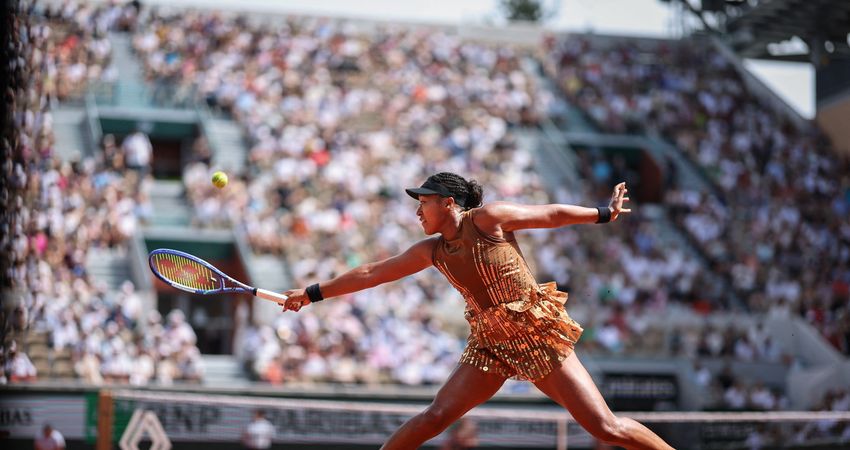
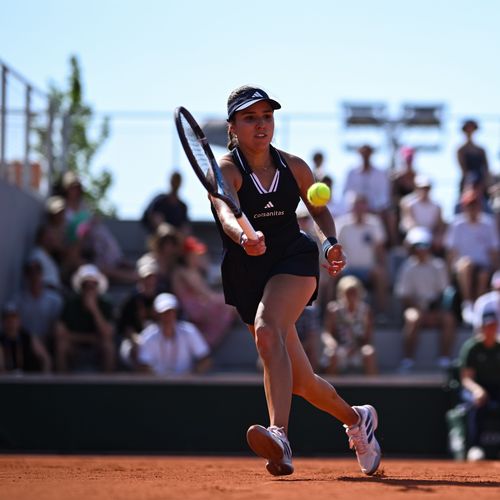
No. 16 seed Naomi Osaka advanced to the second week of Roland Garros for the first time in her career after triumphing in a 2-hour, 58-minute third-round barnburner 7-6(5), 6-7(3), 6-4 over No. 17 seed Iva Jovic. Next up will be the fourth edition of her rivalry with Aryna Sabalenka after the No. 1 seed came from a break down in the second set to defeat Daria Kasatkina 6-0, 7-5.
Former World No. 1 Osaka led by a set and a break, but had to battle hard to quell the 18-year-old American, the second-youngest player to receive direct entry to this year's main draw. It was the first time she had faced Jovic, who reached her first Grand Slam quarterfinal at the Australian Open in January, and the Japanese player needed 46 winners -- including 12 aces -- to come out on top.
"She's an amazing player," Osaka said in her on-court interview. "I'm sure we're going to see her very far in Grand Slams. Well, she already did ... but more."
It was the longest match Osaka had played since the third round of Miami 2025, when she edged Hailey Baptiste 7-6(6), 3-6, 6-4 in 2 hours and 59 minutes, and the joint-second longest of this year's Roland Garros so far -- the same duration as Magda Linette's 5-7, 6-4, 7-6[9] first-round win over Tereza Valentova, but behind Camila Osorio's 7-5, 6-7(6), 7-5 marathon second round over Yulia Putintseva in 3 hours and 30 minutes.
Osaka is competing in her ninth French Open main draw this year, and her win over Jovic was also the first time she has beaten a Top 30 player here. Indeed, it was her best win by ranking at Roland Garros since her tournament debut in the 2016 first round, when she defeated then-No. 36 Jelena Ostapenko -- the following year's champion -- 6-4, 7-5. She becomes the first Japanese player to reach the last 16 here since Shinobu Asagoe in 2004.
In contest decided by fine margins, Osaka stays calm
For almost the whole of the marathon match's running time, there was nothing to separate the two competitors. The first two sets followed similar patterns: an exchange of breaks early on, and a tiebreak ultimately won by the player who'd gone down a break first. But in general, the server dominated: 31 of the first 35 games of the match were holds.
For Osaka, this meant that her serve -- one of the most formidable on the WTA Tour Driven by Mercedes-Benz -- was clicking. She landed 64% of her first serves, and won 79% of those points. While Jovic couldn't match Osaka in terms of speed -- her fastest serve was 110mph compared to Osaka's 123mph -- she was able to deliver efficient, repeatable patterns of play behind her delivery. In particular, Jovic's ability to redirect her backhand down the line was one of the standout shots of the match.
"When I was younger, I didn't have a good serve," Osaka revealed afterwards. "I was a little bit of a pusher. So it's something that I developed later on. I'm really glad that it was working. Against some players, you really need to put your serve in, and she was very aggressive on my second serve, so I definitely felt a lot of pressure."
Both players dealt with that pressure remarkably well. There were plenty of half-chances and moments where momentum could have swung either way -- Osaka missed her first two set points at 6-5 in the first set, and ultimately needed five to seal it; Jovic also came within two points of the second set at 5-4 before running away with the tiebreak. But each time, both demonstrated an impressive ability to shrug off those twists and turns.
The contest was always going to come down to the finest of margins -- and ironically, it was one of the best shots of the day that faltered at the finishing line. Jovic's backhand redirect had repeatedly paid dividends for the youngster, particularly in the second-set tiebreak. But serving at 5-4, 30-30 in the third set, it went into the tramlines to hand Osaka a match point. One netted backhand later, and a terrific contest had suddenly come to a slightly anticlimactic end.
"Honestly, today I was a lot calmer than my first few matches," Osaka said. "In Slams, the further I get, the calmer I am because it's such a privilege to be here."
In her press conference, Osaka expanded on that, citing one particular statistic that coach Tomasz Wiktorowski has been repeating to her.
"I don't know if it's accurate, but it's been helping me out a lot," she said. "He said -- I don't want to tell you guys the numbers, because I'm going to be totally wrong. He basically said Nadal has won 98% of his matches here, and he's only won, like, 50% of the points. I just thought to myself, 'I don't have to win every single point, but I just have to try every single point, and hopefully it goes in my favor.' That's basically it."
Sabalenka vs. Osaka IV awaits
Two 28-year-old four-time major champions will square off for the fourth time in the fourth round of a tournament on Monday -- they have never played at any other stage of an event.
Their first meeting came at this stage of the 2018 US Open -- a match that Osaka won 6-3, 2-6, 6-4 en route to her first Grand Slam title. It would be eight years before they played again -- but this year, they've belatedly resumed their rivalry. It's swung in Sabalenka's favor, with two victories for the reigning world No. 1 in Indian Wells and Madrid, the latter an absorbing 6-7(1), 6-3, 6-2 battle.
Not that Osaka is keeping track.
"I didn't know that," she replied when told she would play Sabalenka for a third time in 2026. "YOLO, like, whatever. I feel like I played her, like I played a pretty good match in Madrid. I think I just dipped in the second and third set. Hopefully just keep the consistency and keep trying to be aggressive. Whatever happens, happens."
Sabalenka agreed about the quality of the Madrid encounter.
"I feel like the last one in Madrid was really tight match, was great level," she said after defeating Kasatkina. "She really stepped in and raised her level in the last match. I'm just ready for the fight. I'm ready to go out there to fight for that match, for that win. Ready to do anything it takes to get the win."
Despite Osaka being just seven months older than Sabalenka, the two players' peaks have yet to overlap. Osaka racked up her four major crowns between the 2018 US Open and 2021 Australian Open -- a period of time in which Sabalenka was yet to reach a Slam quarterfinal. Sabalenka broke through at Wimbledon 2021, and has reached 15 quarterfinals in the 17 majors she has contested since then. Concurrently, Osaka did not make the second week of a Slam between the 2021 Australian Open and 2025 US Open (including a year's absence due to maternity leave in 2023).
Sabalenka's path through the third round was not as fraught as Osaka's, but neither was it straightforward. She raced out of the blocks with a one-sided 25-minute opening set, tallying 16 winners to only four unforced errors and twice breaking Kasatkina from 40-0 down.
But Kasatkina, on the comeback trail from a hip injury, began to assert herself and extend the rallies in the second set. She took a 2-0 lead, and even after being pegged back managed to stay with Sabalenka through to the set's closing stretch.
Errors started to flow from Sabalenka's racquet as Kasatkina started placing the ball into ever-awkward positions on the court -- 23 in total in the second set -- and her frustration was increasingly visible. At 5-4, she came within two points of breaking Kasatkina for the match, only for the Australian to escape; at 5-5, two errant forehands put Sabalenka down 0-30, and in danger of being stretched to a decider.
Enough was enough. Sabalenka blasted through the next seven straight points to reach match point, and duly converted her second as Kasatkina sent a backhand wide.