






We're officially 50 days out from the year-end WTA Finals, which will be contested at the iconic Indian Wells Tennis Garden.
The premier tournament on the WTA Tour Driven by Mercedes-Benz calendar, the WTA Finals features the top eight singles players and top eight doubles teams, pitting them against each other in a round-robin format to crown a WTA champion.
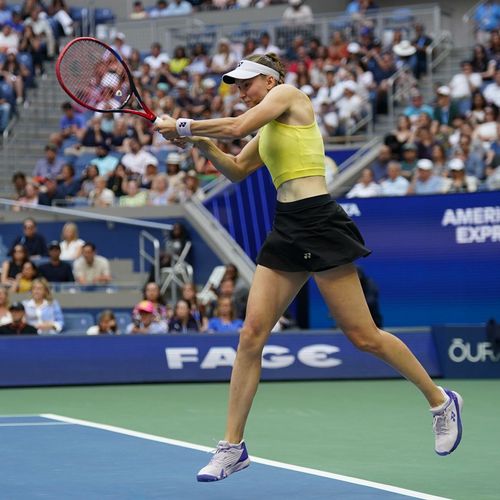
As we enter the final stretch of the season, only one singles player has qualified for the Finals. Elena Rybakina, who currently leads the PIF WTA Race to the Finals with 7,492 points, qualified after winning the US Open.
Aryna Sabalenka is currently in second, with 6,485 points, and Jessica Pegula (5,825), Coco Gauff (5,654) and Mirra Andreeva (5,614) round out the top five. Elina Svitolina (4,809), Karolina Muchova (4,400) and Linda Noskova (4,234) would have the final three slots, if the season ended today.
But the season isn't ending today. In fact, after the Hard-Court Swing concludes in Guadalajara and Sao Paolo this weekend, there are still eight tournaments that count towards the Finals race. Two of those tournaments, which will be of most consequence to the leaderboard, are back-to-back WTA 1000s in Beijing and Wuhan.
Ahead of the season's culmination in Indian Wells, as we shift our focus to the Asian Swing, here are three burning questions about Finals qualification and the year-end rankings.








|
1
-
|
8,370 | |
|
2
-
|
6,503 | |
|
3
-
|
5,638 | |
|
4
-
|
3,566 | |
|
5
1
|
3,035 | |
|
6
-1
|
3,018 | |
|
7
-
|
2,898 | |
|
8
3
|
2,418 |
1. Which players on the outside looking in have the best chance to qualify?
Noskova is in excellent standing to qualify, despite being in the eighth spot. As a Grand Slam champion this year, she'd have to fail below No. 20 on the leaderboard not to qualify. That means even if Noskova struggles during the Asian Swing and drops several spots, she'd still be headed to Indian Wells.
With Noskova in firm position, the two players currently on the outside looking in -- Marta Kostyuk and Iga Swiatek -- are chasing Muchova and Svitolina. No. 9 Kostyuk (3,850 points) currently trails Muchova and Svitolina by 550 points and 950 points, respectively. Swiatek (3,584 points) trails Muchova by 816 points and Svitolina by 1,225 points.
Kostyuk pulled out of next week's Billie Jean King Cup quarterfinal, citing the need for additional recovery time for her injured wrist, though she's still currently scheduled to play Beijing and Wuhan. She earned 108 points by reaching the quarterfinals in Guadalajara this week, after Taylor Townsend pulled out before their match, but missed an opportunity to earn more after falling to Liudmila Samsonova in her next match.
Kostyuk played only the two WTA 1000s during last year's Asian Swing, going just 2-2 across Beijing and Wuhan, so she'll need much stronger results there next month to sneak into the final eight. She'll also likely have to play additional tournaments during the swing. There are three 500 tournaments left on the schedule, though she's not playing the first one, next week's Singapore Tennis Open. Last year, Rybakina won six straight matches at WTA 500s, including a title in Ningbo, to sneak into the WTA Finals field.
As for Swiatek, she is the defending champion in Seoul, though she won't be there this year after that tournament was changed from a 500 to a 250. She had modest runs at the Asian WTA 1000s last year, reaching the Round of 16 in Beijing and the quarterfinals in Wuhan, but will have to go deeper this fall.
Swiatek is a former champion in Beijing, though she won it back in 2023.

2) Who will finish the season as the year-end No. 1?
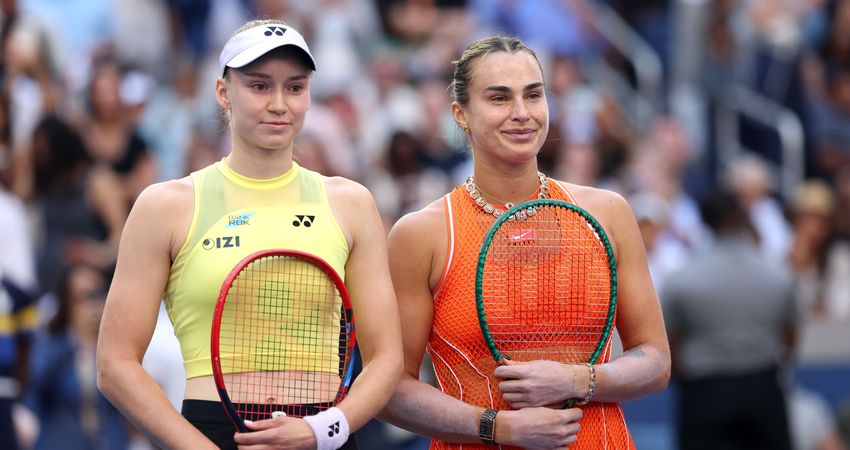
Sabalenka, currently second in the PIF WTA Race to the Finals, is on the doorstep of qualification. In fact, she would have qualified with a win in the US Open final. So there's no drama there.
There is drama, however, when it comes to the year-end No. 1 ranking, which Sabalenka has finished with each of the last two years.
The PIF WTA Rankings race is different than the PIF WTA Race to the Finals, as rankings points have to be defended from the season prior. Currently, No. 2 Sabalenka trails No. 1 Sabalenka by a healthy 2,026 points in the PIF WTA Rankings.
Sabalenka, who hasn't won a title since Miami in March, didn't play the China Open last year, so there's ample opportunity in Beijing next month. She'll be defending 390 points in Wuhan, where she reached the semifinals in 2025. She'll be further boosted if she decides to play one of the two WTA 500 events after Wuhan.
Rybakina played far more during the Asian Swing, though the points she's defending at the 1000s are reasonable after reaching the third round in Beijing and then the quarterfinals in Wuhan. It was after that that she got red hot, with a title in Ningbo and a semifinal run in Tokyo. Should she play those events, she could potentially drop points with lesser performances.
It could very well come down to the WTA Finals, where Rybakina is defending 1,500 points as the defending undefeated champion. She defeated Sabalenka, fittingly, in the final last year. Wouldn't it be something if they met again at that stage, for the year-end No. 1 ranking?
One thing to keep an eye on is Rybakina's health. After suffering a left ankle injury in Cincinnati last month, she didn't play for a week and said it hurt to walk. She looked healthy at the US Open, but has pulled out of next week's Billie Jean King Cup quarterfinals to rest and recover further.
3. Which American will be ranked highest at the end of the year?
Like Sabalenka, Pegula and Gauff have a clear look at the basket at No. 3 and No. 4, respectively, on the PIF WTA Race to the Finals leaderboard, and should qualify for the Finals assuming they play to their standard in Asia.
But who outranks the other at the end of the year remains in question. Gauff was the highest-ranked American at the end of last year, finishing No. 3 ahead of No. 4 Amanda Anisimova and No. 6 Pegula.
Pegula has made inroads since then. She's currently the highest-ranked American, at No. 3, but only by a smidgen. Gauff, ranked fourth, trails Pegula by a minuscule 21 points. They both held serve at the US Open, reaching the semifinals in New York, but Gauff will have more points to defend in Asia. She took nine of 10 matches at the back-to-back 1000s last year, getting to the semifinals in Beijing before winning the title in Wuhan. She has traditionally played some of her best tennis at those tournaments, and she'll need to be almost perfect again not to lose points.
That doesn't mean it will be easy for Pegula to catch her, though. The 32-year-old also had a terrific Asian Swing last year, albeit slightly worse, reaching the semis in Beijing and then the final in Wuhan (where she lost to Gauff). That final, it turns out, gave Gauff the slight points edge during the swing.
Like the quest for year-end No. 1, it will very likely come down to the WTA Finals. Gauff will have a chance to make a push there, assuming she qualifies, after not getting out of the group stage last year. Pegula, meanwhile, will be defending semifinal points.